by Meg Neufeld | Jul 17, 2016 | Creative Arts Programs, Open Studio Sessions

Carve out a reflective space and create the right environment
Create a creative and healing environment for yourself: Do not underestimate the power of interior decorating! Surrounding yourself with inspiring artwork, writing and decor can help lower stress, alleviate the burden of chronic disease and chronic pain, and can even enhance patient care while in hospital and even lead to earlier discharge.
No wonder there is big business in hospital renovation and beautification projects! British Columbia’s Children’s Hospital is currently calling all artists to decorate and inject art throughout the new hospital. Push the laptop aside and replace it with a nice container of coloured pencils for sketching, replace an empty wall with an art piece that brings you joy every time you look at it! Carve out a special spot of your own that will help you be creative! Make it a place that you will be drawn to, be creative in it, and find reflection, rejuvenation, and relaxation. Adding cool tones to a space such as green, pink and light purples and blues brings relaxation, while oranges and reds are energizing. However you choose to create your space, remind yourself that this space is your safe space to engage with your own thoughts and emotions.
3 Ways To Start Your Own Self-Reflection
Why not introduce yourself to creative writing and enjoy the self-reflective and stress-relieving benefits of it! Here are three ways to start your own reflective process:
- Draw or write your anxieties on a chalkboard or white-board then wipe the slate clean! The act of expressing your cares, seeing them in front of you and washing them away can be very therapeutic!
- Focus on a motivational message, quote, poem, or favourite passage. What will uplift you? Learn it by heart, write it out, or draw out an image reflecting what it means to you. Write it on a sticky note and post it everywhere: your fridge, car, bathroom mirror. Revisit your quote throughout the week, especially when you feel down. Incorporate it into an art piece by drawing, sketching and painting it! Here is a link to some ideas!
- Start a journal. It’s not as daunting as it sounds. Having a place to do some creative writing, or to write about your thoughts and life experiences throughout the week allows you to process your emotions, and may help you to see some of your life situations and feelings in a different light. Regular journaling, no matter how mundane the entries, offers a quiet space for you to take time for yourself! Set the tone by seeking out a great journal and pen of your liking to make the activity that much more enjoyable! Add a hot beverage and your quiet time will rock!
3 Ways to start your journey in the studio this week
- Do a self-reflective art project: make a collage or a mask! So much of healing comes from self-reflection and building self-confidence. Making pieces such as a self-portrait or art piece using collage materials, or creating a mask out of clay or paper maché are projects that can help us do some soul searching. Be inspired as you go! Tear out words and images from the paper or a magazine that speak to you and arranging them on the page. During the process, a theme often emerges and the final image expresses elements of a message or aspects of us in a visual way.
- Try art journalling. If you like journaling but want to add some artistic and visual flare to your pages, try art journaling! Art journaling is more than a passing fad. Many people have found this type of artwork very reflective and rewarding and are passionate producers of beautiful and elaborate pages. Use your favorite poem, short story, or narrative and ask yourself how it can be translated in an interesting way to the page using words and images. Have a look at some examples: no need to be intimidated, art journaling is one’s personal thoughts and dreams in visual form and we have a wide variety of suggestions, prompts, creative journaling project pages waiting just for you! Just select a project page that interests you get started on your version of it! We have a wide variety of materials that can be used in the art journaling process such as watercolour pencils, crayons, or pallets, chalk or oil pastels, fine line coloured pens and sharpies, inks and stamps, multi-media paper products, stencils and templates, and even books and books of visual and literal inspiration! During our open studio sessions we will even give you the best tips and techniques for you to use at home, on the go, and in studio!
- Use our creative writing prompts. We have a great selection of writing and drawing prompts geared towards all ages that will keep your hands and mind moving! Write about whimsical things such as a short story that includes a prince, a tractor, and a magical frisbee! Or explore on a deeper level and write about a time when you truly felt yourself. Then you can really start to explore what motivates you to create art, to write, to dance, sing and even be a good friend. No need to share your writing in the studio unless you want to! Your work is yours!
…Write Right Now!

by Brenna Jacobson | Jul 13, 2016 | Counselling, Group Therapy, Therapeutic Yoga
Everywhere I look, Trauma Sensitive Yoga is the hot topic currently in the spotlight. Why the sudden interest in this topic you may ask? The federal government is contributing 1.2 million dollars to a research pilot-project in British Columbia for women in transition, and people are wondering if the costs are going towards a viable solution. The feds are headed in the right direction. After decades of relatively stagnant structure and programs, the federal government is finally realizing there has been a vital missing link in past approaches to ‘holistic’ healing in western society. We have been ignoring an essential part of the healing process, the physical body.
Treating trauma involves treating the whole person. Specifically in the treatment of trauma, Registered Yoga Therapist (RYT) David Emerson and Dr. Bessel van der Kolk, renowned researcher in Post Traumatic Stress Disorder (PTSD), have collaborated since 2003. They have been developing the Trauma Sensitive Yoga program in the Trauma Centre at Justice Resource Centre, Brooklyn, MA.
A Solution for Many Traumatic Conditions
Trauma Sensitive Yoga is designed to help heal women who’ve been through domestic violence as explained in the recent article from CBC, Wednesday June 22, 2016. However, Trauma Sensitive Yoga has been known to help a broader audience. Those who benefit from Trauma Sensitive Yoga include: survivors of rape, childhood abuse, neglect, mental abuse, war vets, and at risk youth just to name a few. This process is even able to help people in other areas we might not usually think of as trauma, such as women with fertility problems.No trauma is more important than another. All traumas are alike where we feel disconnected from our true self. People with trauma feel a sense of powerlessness and lack of control over their outcomes
Although we may not like to admit it, we are all victims of circumstances in life. Our misfortune could be caused by certain events such as trauma, the ‘Frustration Cycle’, or our inner wisdom being clouded by buried false beliefs about ourselves that are negative and self-destructive. According to the International Journal of Yoga Therapy, No. 19 (2009):
Traditional trauma therapy is talk-based and focuses on the mind, the story, tending to neglect the physical visceral and body-based dimension of trauma. An essential aspect of recovering from trauma is learning ways to calm down, or self-regulate. For thousands of years, Yoga has been offered as a practise that helps one calm the mind and body. More recently, research has shown that yoga practices, including meditation, relaxation and physical postures, can reduce autonomic sympathetic activation, muscle tension, and blood pressure, improve neuroendocrine and hormonal activity, decrease physical symptoms and emotional distress, and increase quality of life. For these reasons, yoga is a promising treatment or adjunctive therapy for addressing the cognitive, emotional and physiological symptoms associated with PTSD specifically.
In a pilot study done at the Justice Resource Centre on the effectiveness of yoga on PTSD symptoms, there were findings that state some of the findings state that,“After eight weeks, the yoga participants showed improvements in all dimensions of PTSD, an increase in positive affect and decrease in negative affect, and an increase in their physical vitality and body attunement.”
According to Dr. Jeff Morley, a registered psychologist for the Canadian centre for Police and Emergency Resilience, PTSD is no longer being classified as a mental ‘disorder’ but will be recognized as an involuntary injury. This gives rise to a more expansive umbrella for the injury. New more inclusive terms such as Post Traumatic Stress Resilience (PTSR) and Post Traumatic Stress Injuries (PTSI) are more accurate at describing what people are going through.
by Meg Neufeld | Jun 27, 2016 | Creative Arts Programs, Open Studio Sessions
Ever tried India Ink?
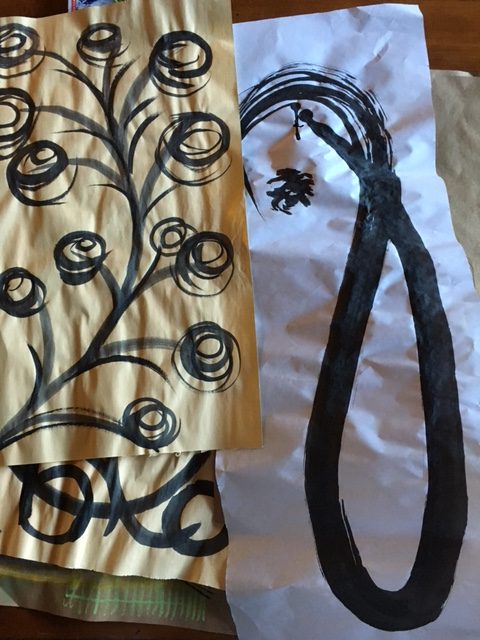
Explore India ink. It is dark, rich, and smooth. It covers the page in such a effortless way. Create your own symbol using ink, try making something from ink blots, or try your hand at calligraphy.
Please note: The Open Studio Sessions will not take place Monday June 27th due to an event. We’ll be open as usual Wednesday June 29th from 10am-1pm!

by Andrew Neufeld | Jun 16, 2016 | Counselling
In part 1 of this post, “The problem with the lack of governing body in counselling,” shows why it’s important for all counsellors to meet the professional standards and ethical requirements for counselling. People have the right to know the counsellor they’ve chosen come from a background of qualified counselling. These qualifications can come a degree, or some form of proof attendance and completion of school. Clients can then rest assured the counsellor of their choice sufficient knowledge in their field. All counsellors should have proof that they’ve spent sufficient time in researching and learning the methods of clinical practice.
What To Watch Out For When Choosing a Counsellor in British Columbia
Understanding what to look for when choosing a counsellor is super important. The emerging trend of something called “competency based counselling” is incredibly troubling. “Competency based counselling” suggests that life experience and a little bit of training is an adequate substitute for years of schooling, ongoing professional development, and clinical supervision. There are a number of organizations being formed right now based on this idea. The scary thing is these organizations look every bit as official and professional as their authentic counterparts. Especially to those who don’t know the counselling profession that well. It is very important to know that these organizations aren’t regulated for meeting standards that the BCACC, CCPA, and BCAMFT do.
Here’s a question for you: would you be comfortable going to seek medical advice or treatment from someone who hasn’t gone to medical school? Most likely not. Based on the “competency based” approach, someone who has worked alongside doctors and completed a few courses on medical issues would be equal to someone who has completed medical school. This is precisely what some of these “competency based” organizations are suggesting you should do for counselling. This is not okay. It is completely unethical.
Counsellors are specially trained to work with people who are going through some of the most difficult experiences in life. Further, our work has a direct impact on thought processes, social relationships, daily functioning, and a lasting physiological effect on the brains of our clients. There are quite literally thousands of studies documenting brain changes based on psychotherapy. This is not something to be taken lightly – working with a counsellor has the potential to affect your brain chemistry. This is why it is so important that your counsellor has proper training and experience before you allow them to significantly influence your life.
What To Look For In A Counsellor
The first thing I would look for in a counsellor is that they are a member of one of the three organizations mentioned previously (BCACC, CCPA, BCAMFT). If you are seeing a Psychologist, make sure they are part of the College of Psychologists of BC. This will assure that they have met the minimum requirements set out by counsellors and/or psychologists who have been practicing in the field. It also protects you because they are under obligation and held accountable to meet ethical standards.
If a counsellor is not a member of one of these organizations, I would question their qualifications. Sometimes, a fresh graduate with a Masters degree or Ph. D may be waiting to hear back from their application or have to take additional courses to meet criteria differences between countries. Aside from these reasons, every counsellor or psychologist should be part of one of these three organizations.
Questions To Ask Your Counsellor
Sometimes it is hard to know what type of questions to ask. You might want to find out if a counsellor’s training is adequate. Or what their experience is. Or if they are going to be a good fit for you as a client. Here are a few sample questions you can ask any counsellor. These are designed to help you get information on their training, clinical background, and whether they are what you are looking for:
- Where did you get your training? What were your undergraduate and graduate degrees in?
- Where were your practicum / internship placements?
- What professional training have you completed after graduating?
- Do you currently have a Clinical Supervisor? If not, why not?
- What is your experience in professional practice? What settings have you worked in (Hospitals, Outpatient Clinics, Private Practice, Other)?
- What experience do you have working with the issues I am dealing with? How long do you think it will take to see change?
- What made you decide to become a counsellor and what are you passionate about in your work?
The last question may seem strange. However, so much of effective counselling relies on the personhood and humanity of the counsellor. Always ask your counsellor questions that relate to their education, training, and clinical experience. The most overlooked but equally important question is “Why are they doing this? Are they in it to help clients move forward in life?” In my experience, clients who ask these questions gain a better insight of whether or not the counsellor-client relationship will be a good fit.
Closing Thoughts
I hope this article helps you in choosing the right counsellor. It’s important to know what to look for and what to be careful of in order to be a wise consumer. Registering body like the BCACC, CCPA, BCAMFT, or College of Psychologists of BC help professionals stay on top of their profession, education, and ethics. It also provides clients with reassurance that the professional has met certain standards and are reliable professionals. “Counsellors” who don’t meet these standards, or believe in “competency based” may have the good intentions but they lack the expertise of someone who has spent years in school.
You want a professional that has gone through adequate learning, practice, and who complies to the regulation of a professional body. A professional who meets these requirements have your best interests at heart. Not someone who claims to but does not want to go through the necessary schooling or training for the profession. It is my hope that this article helps clients feel confident in their ability to make wise decisions in their counselling journey. As well as encourage professionals to maintain the highest standards of professional practice in our desire to help others.
To learn more about the professional bodies, please check out their respective websites.
BC Association of Clinical Counsellors (BCACC)
http://bc-counsellors.org
Canadian Counselling and Psychotherapy Association (CCPA)
https://www.ccpa-accp.ca
British Columbia Association for Marriage and Family Therapy (BCAMFT)
http://www.bcamft.bc.ca
by Brenna Jacobson | Jun 13, 2016 | Events, Therapeutic Yoga, Workshops
Introduction To Therapeutic Yoga
Wednesday July 20th, 7:00-8:30pm
Location: Alongside You – #203-4840 Delta Street, Ladner
Presenter: Brenna Jacobson, Registered Fitness Professional, Therapeutic Yoga Instructor
Cost: $20 (plus GST) each participant
Click here to register now!
Curious about Therapeutic Yoga and whether it’s for you?
Come and join in this informational workshop that will explain how Therapeutic Yoga supports your individual needs. You will have the opportunity to ask questions, and experience some examples of what it involves as you are guided through some of the techniques used in specific circumstances.
We believe that this workshop will be eye opening as you discover this profoundly useful tool in restoring harmony and balance into your life.
Partners are welcome to attend. Private sessions available upon request to provide ongoing guidance for physical and emotional support.
** Please bring your own yoga mat **
Have questions? Please call Brenna at (604) 283-7827 ext. 8 or email brenna@alongsideyou.ca

by Andrew Neufeld | Jun 9, 2016 | Counselling
Two of the most frequently asked questions I get from people is, “How do I choose a counsellor?” and “How do I know what to look for when I’m choosing a counsellor?” These are very important questions I’m always happy to answer. Nowadays it’s critical to be a wise consumer of mental health and other counselling services. Especially since not all services or service providers are the same. Be careful of the options in the community that look “official” but the counsellor is not actually professionally qualified.
The Problem with the Lack of Governing Body in Counselling
One of the biggest problems in British Columbia is that there is no College for counsellors. A College is a regulatory body, established in the province of British Columbia to regulate a profession. The College abides by the Health Professions Act, or in the case of Social Workers, the Social Workers Act. The lack of a College for counsellors is a problem that counsellors have been trying to fix for over a decade but have not been able to for many reasons that are beyond the scope of this article. Doctors, social workers, nurses, and psychologists all have a College that is regulated by the province with specific entrance requirements, ethical standards and ongoing training requirements. These requirements ensure that anyone calling themselves a doctor, social worker, nurse, or psychologist have met these requirements (assuming they can prove registration with the college). While no system is perfect, you can at least be assured that certain minimum standards are maintained in professions that are regulated under a College.
Not having a College for counselling profession in British Columbia is a major problem. Think about it. You could literally drop out of high school, put up a sign, and call yourself a counselor. There is absolutely nothing illegal about this, and quite frankly, this happens far more frequently than it should. This is why it is very important to know what degrees and credentials to look for when you’re choosing a counsellor.
The Current Solution – Self Regulation
Thankfully, we have a solution called self-regulation. It’s not a perfect solution but it’s the best we can do for the time being. There are three major registering bodies for counsellors in BC that are responsible for self-regulation in counselling. They are: the BC Association of Clinical Counsellors (BCACC), the Canadian Counselling and Psychotherapy Association (CCPA), the British Columbia Association for Marriage and Family Therapy (BCAMFT). These organizations were created by counsellors in the profession who wanted to ensure a minimum level of professionalism was met. The minimum level of professionalism includes meeting mandatory education requirements and ethical standards. Self-regulation means there is a complaint process for the public that ensures accountability. The regulating bodies also require ongoing education where counsellors continue their education on the latest research and treatment methods.
All of these organizations require a minimum of a Masters degree in the field of psychology, completion of practicums/internships, and guidelines for ongoing supervision while in clinical practice. Certain requirements must be met to be covered under professional liability insurance which acts to protect the interests of both counsellors and clients.
How Does This Affect You?
Just as in any other profession, it is necessary that counsellors meet professional standards and ethical requirements. Our clients should have confidence that their counsellor has gone through proper training. Proper training includes time spent at school learning counselling theory, conducting research, and practicing the methods of clinical practice that have been shown to be beneficial to clients. Counsellors should have gone through professional training via internships where they were supervised by counsellors who have been in the field for many years. Training under such guidance can enhance their learning and practice so they become effective at helping others.
It is essential to have professional standards for ongoing supervision and accountability. These standards validate a counsellor’s commitment to ongoing learning. They also serve as a source for counsellors to seek help from when they need additional insight into the difficulties of their clients. Professional standards and regulations help ensure counsellors are always acting in the best interests of their clients and always doing so in an ethical manner.
Finally, it is important to have a process in place for complaints. This provides clients with a method for recourse if they feel a counsellor is not acting ethically. This insurance helps protect both clients and counsellors. Especially in cases of legitimate claims or false allegations. Without a governing body, there is no oversight for these very important areas.
Our next article will explore what to look for when choosing a counsellor. There are certain things you need to watch out for and specific questions you should be asking. There is a lot at stake. Your mental health and the mental health of your loved ones can be deeply affected by the counsellor you choose to see.
Update: Continue to Part 2 of the blog – The Difficulties with Choosing A Counsellor in British Columbia – Part I
To learn more about the professional bodies, please check out their respective websites.
BC Association of Clinical Counsellors (BCACC)
http://bc-counsellors.org
Canadian Counselling and Psychotherapy Association (CCPA)
https://www.ccpa-accp.ca
British Columbia Association for Marriage and Family Therapy (BCAMFT)
http://www.bcamft.bc.ca
by Brenna Jacobson | Jun 9, 2016 | Pelvic Rehabilitation, Therapeutic Yoga, Workshops

Yoga For Fertility Workshop
Wednesday August 3rd, 6:30-9:00pm
Location: Alongside You – #203-4840 Delta Street, Ladner
Presenter: Brenna Jacobson, Certified Pre-Natal Consultant/Yoga Fertility Instructor
Cost: $49 individuals/ $69 couples (plus GST)
Click here to register now!
Availability: We require a minimum of 3 individuals/couples and a max of 10 to run the workshop. We will refund all fees if a cancellation occurs and will give as much notice as possible to clients.
An introduction to yoga, meditation and self-nurturing and how it can help you discover ways to support physical health, relieve stress, let go of negative thinking and nourish your reproductive well-being. We will explore:
- Principles of Yoga for fertility: Awareness, Acceptance, Grounding, Centering
- Postures and modifications to guide and support your efforts
- Body awareness – Listening to your body and responding
- Fitness, Active Lifestyle and Core Training for fertility
- Restorative Yoga to open lines of energy through the body and create harmony and ease
- Relaxation and meditation techniques and breathing
- Create a positive self-image and practice positive thinking
- All students will receive a handout complete with a 30 minute home practice
Partners are welcome to attend. Private sessions available upon request to provide ongoing guidance for physical and emotional support.
** Please bring your own yoga mat **
Have questions? Please call Brenna at (604) 283-7827 ext. 8 or email brenna@alongsideyou.ca
by Alongside You | Jun 7, 2016 | Creative Arts Programs, Events, In The Community

Friday Night Knitting Club Is Back!
Friday, June 17th, 2016 from 7:00 pm to 10:00 pm
The fourth Friday Night Knitting Club event is this Friday at our offices! If you’re not sure what the Friday Night Knitting Club is, you’re missing out! You’re invited to a casual evening of knitting and socializing in the heart of Ladner Village! If you have always wanted to try knitting, want to hang out while working on one of your pieces, or would like to share your stories and skills with others, this is the place for you! Bring your own yarn and needles or purchase yarn for $6 and needles for $1. Guidance for beginners will be available.
Admission is by donation. Coffee and tea will be provided, bring a treat to share if you like! Hope to see you there!
If you’d like to read the book that started it all, you can get a copy at Black Bond Books and mention this event to receive 10% off. Or, click here to buy your Kindle edition online in time for the event!
No tickets necessary, but if you’d like to let us know you’re coming, please let us know on our Facebook Event page, by clicking here!
All proceeds go toward our Step Forward Program, providing financial assistance to clients who may need some additional help subsidizing our services.
by Meg Neufeld | Jun 5, 2016 | Creative Arts Programs, Open Studio Sessions
Use alcohol inks to create art in a new way!
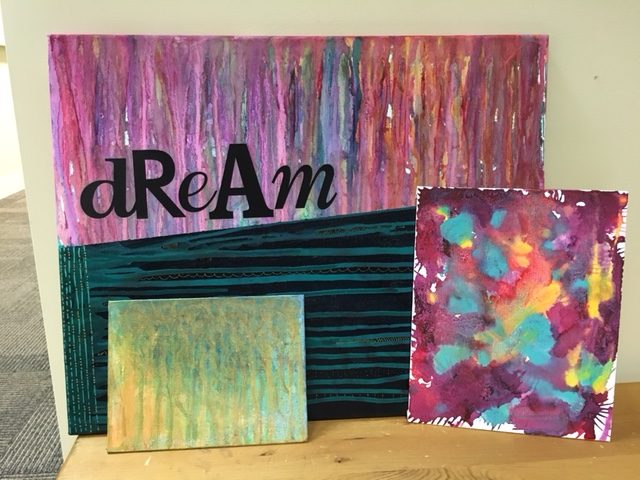
Explore alcohol inks and what they can do! Create a wide range of work from brightly coloured panels, marbled images, and subtle landscapes using the drip technique. Learn how to make and mix your own!
by Meg Neufeld | May 31, 2016 | Creative Arts Programs, In The Community

“Art washes away from the soul the dust of everyday life.” – Pablo Picasso
by Meg Neufeld and Mary Ann Burrows
Everyday life can be monotonous, full of repetitive tasks and, yes, even dusty, from the time we wake until we hit the hay.
Finishing off the last bites of our regular breakfast of choice, most of us face the day trying to get through our never ending “to-do” list of chores and errands, care for family members and drive carloads of folk from one appointment or activity to the next.
Art, however, can bring vibrancy to our daily grind. Art sparks curiosity and creativity; it makes the colourless colourful, the dull bright and the dreary shine.
Not sure how to add a little art and creativity to your day? You might be surprised… you may already be doing it.
Creative activity awakes the senses and can mean doing anything from taking a walk through a museum, gardening, making a batch of cookies, viewing the local high school theatre production, making a card for someone, writing in a journal, knitting, taking photographs or painting a picture. In the process, we’re creating.
By making decisions about what we like and don’t like, we’re on the path to discovering our own interests, opinions and tastes.
Art helps us to think about the world around us in new and exciting ways, and helps us discover more about ourselves as individuals and what we want to share with those around us.
When we do something creative we are “self”-making.
Not only does art allow us to self-reflect, it has a positive impact on our overall health and wellbeing.
Research shows that participating in creative activity can have a positive influence on health outcomes.
It can decrease symptoms of depression and anxiety; improve memory, problem solving and other cognitive functions; increase cardiovascular health and help address daily mobility and balance issues; improve social isolation and crossgenerational learning; and provide an outlet to explore difficult emotions while promoting personal growth and healing.
It can also be used as a tool to manage persistent chronic pain and a variety of other chronic illnesses.
Consider the satisfaction you get when finishing a page-turning book, the calm you feel as you view a beautiful sunset
filled with indescribable colours, the connection you feel when you share your passion with someone else, the wonder when you paint something new, or hear music that moves your soul.
Whether you are drawn to the visual, literary, performing arts, design, music or dance, creative moments like these help us to live a healthy and balanced lifestyle and they enrich our everyday life.
We look forward to walking with you as we explore themes on arts and aging, mental health and wellness, inspiring and creativity boosting activities, and share with you art stories on influential people, places and things.
For now, take some time this month to connect with your creative side by trying something new, or to reconnect with something you haven’t done in a long time.
The time is now: live An Art Full Life!
Meg Neufeld is a cultural anthropologist, practicing mixed-media artist and program director at Alongside You, a health organization that offers a multi-disciplinary approach to health, and where creative activity is encouraged amongst people of all abilities for overall health and wellness. Mary Ann Burrows is an artist, and the president and founder of Artists in the Village, a non-profit society that focuses on inspiring creativity within each other and the community through connection, expression and awareness.