by Meg Neufeld | Nov 9, 2017 | Articles, Chronic Illness, Creative Arts Programs
You wake up and it’s still there; that dull pain in your body that reminds you of your chronic condition. You feel like staying in bed all day, but you know that would leave you in even worse shape. So, what can you do to get through the day? Here are five ways to manage daily chronic pain:
- Begin to breathe – with intention.
Yes, breathing is essential to live, but doing mindful breathing can calm our body, focus our mind, and alleviate stress. Sit comfortably with your eyes open or closed. Start by breathing in and out, noticing the rise and fall of your breath, and the sensations in your body (shoulders, stomach, nostrils). Notice all the sensations all around you (smells, sounds, presence). Take deep breaths through your nose as slow and controlled as possible, and exhale through your mouth as slow and controlled as possible. Try to make this process of breathing in and out last for a total of 7 seconds or more. Refocus your gaze to end the exercise.
- Be realistic of daily goals.
The busyness of life doesn’t stop for someone who has chronic pain. Those of us who have daily pain, however, need to prioritize daily activities and goals based on how we are feeling on any given day. It’s a hard pill to swallow realizing that we can’t do it all. Start with having just one or two things on your “to do,” list for the day, week, or month. Empty the dishwasher, check. Pick up library books, check. Starting small and completing a short list of manageable goals will reward you with a great sense of accomplishment.
- Get moving.
Even though our natural tendency is to want to curl up in a ball when we are in pain, staying stationary is one of the worst things we can do. Our brain and body need stimulation and range of motion to heal and to cope with pain. Staying active may look different to people based on their pain. For some, a successful active session can be as simple as walking down the block and back each day and for others, doing moderate cardio activity for 20 mins a couple times of week is right for them. Change it up every once in a while to make exercise fun and interesting. Don’t forget to add some intensity or to lengthen the duration of your exercise sessions every now and then. Doing too much too soon may backfire, but test your limits – you never know if you can do something until you try!
- Rest well
Alternate your day between periods of activity and periods of rest. Start by setting aside just 30 mins of your day to rest your body and mind well. By well, I mean ‘set the stage’ to help you have the best rest possible. Based on your pain, find a comfortable place to rest with some of the following: low light, heat pack, ice packs, eye patches, soft music, a mindfulness meditation app or even have a hot bath. Maximize your time of rest and it will help get you through other parts of your day!
- Tap into your spiritual side
Yes, this may be uncharted territory for some, but reading, journaling, praying, making art, or listening to something meaningful can help you to self-reflect, manage your emotions, set goals, and can really put things in perspective. There are times in your chronic pain experiences where you will need to draw inner strength, so make sure to build it up!
For many of us, chronic pain is here to stay so we might as well learn how to cope….HAVE HOPE.
Want to learn a new way to cope with your chronic condition or chronic pain? I am leading a new course on chronic condition and chronic pain management through mindfulness based art practices in January. See below and check it out, I’d love to have you!
Learn more
Meg Neufeld, (MA) is the co-founder of Alongside You, an integrated health clinic that offers yoga, pelvic rehab, registered dietitian services, clinical counselling, group therapy, and therapeutic arts. As a cultural anthropologist and an artist herself, Meg seeks to make art accessible to people of different abilities, diagnosis and age. She is trained in Mindfulness-Based Art Therapy practices and has a particular interest in using art as a pain-management strategy in her own life.

by Meg Neufeld | Oct 31, 2017 | Chronic Illness
What is chronic pain?
Most of us have felt physical pain before: we’ve pulled a muscle, had a headache or bumped our funny bone (which really isn’t very funny at all!). The pain we experience is our body telling us something is wrong and after a period of rest and healing (up to three months), we can typically go back to normal activities. Chronic pain is when our brain is in an ongoing state pain and heightened sensitivity that persists longer than 3-6 months. Despite common understandings of pain as being a purely physical reaction, pain is actually directly linked to our brain and nervous system. This video highlights the complexities of our brain and nervous system and identifies the ways in which medication, exercise, diet, medical procedures and emotional processing can help retrain the brain and improve the quality of life for those who suffer from chronic pain.
Whether persistent pain takes the form of back pain, migraines, arthritis, fibromyalgia, endometriosis, lupus, other invisible illnesses, the chronic pain experience affects the body, mind, and soul. While each person’s experience with pain is different, there is a range of common threads:
- Everyone has their own definition of a good day and a bad day. Simple tasks may be manageable one day and not the other.
- In order to “self-manage” daily symptoms, there is a constant need to balance or carefully plan periods of rest, work, exercise, social activities, diet, sleep, and spiritual connectedness.
- It is challenging to talk to family and friends about our pain. The impact on family and friends can be devastating as roles, expectations, and relationships change because of the pain.
- Pain is challenging to treat. The constant rotation of medical appointments, medications and medical procedures can be exhausting and what may work for one person, may not for another.
- Chronic pain goes hand-in-hand with mental health and evokes strong emotions as attempts are made to cope with a loss of purpose, former abilities and relationships.
How can we tackle chronic pain?
The chronic pain experience is riddled with complexities; it has both physiological and psychological components, making a holistic approach in tackling chronic pain the most effective way to approach treatment planning. This video highlights the importance of a multi-disciplinary approach. As a result, we need to find ways to reboot our nervous system, learn productive skills to manage our symptoms, help educate others on chronic pain experiences, and strive to have a better quality of life.
HOW MINDFULNESS-BASED ART ACTIVITIES CAN HELP PEOPLE WITH CHRONIC PAIN
“Art gives a face to the ambiguity of chronic pain …
it gives a visual expression to something that is often elusive.”
–Dr. Steve Feinberg, American Chronic Pain Association
What are the overall health benefits of making art?
Using art for its health benefits is widely becoming a critical component of healthcare. Art helps us explore, practice and develop our creativity as a means to promote health and well-being. Making art has several benefits in key areas:
- Mental Health: Making art reduces stress, protects against depression and anxiety, can improve self-confidence[i] and encourages positive self-care. Doing something creative in a supportive and safe environment encourages experimentation and risk-taking, two essential qualities of the art-making process.[ii]
- Social Health: Those that participate in creative activities are more likely to have wider social networks with people from different backgrounds, have a sense of belonging, and are less likely to be socially isolated and lonely.
- Brain Health: Art making is an effective preventative tool in managing symptoms of diseases such as Dementia, Alzheimer’s disease, and other chronic conditions. It also improves memory processing, problem solving, and helps to maintain neuro-spatial functions as we age.
- Emotional Health: Creative engagement can provide a healthy outlet or path to healing for those who have suffered trauma, abuse, or significant life changes. Doing something creative can act as a distraction tool and is another way to preserve self-identity and move forward.
Using Mindfulness-Based Art Therapy (MBAT) techniques to tackle chronic conditions
According to Jon Kabat-Zinn, a leading researcher on mindfulness-based programs, mindfulness is, “the ability to become fully present in this moment, in a particular way, with a non-judgmental attitude.” [iii] Combining mindfulness skills while making art can be an effective way to manage symptoms of depression and anxiety, improve pain tolerance, and elevate the quality of life of people with chronic pain [iv] [v] and illness,[vi] including those with arthritis[vii], Dementia and Alzheimer’s disease[viii], and cancer.[ix]
Why does MBAT work for chronic pain management?
Mindfulness is a frame of mind; a decision is made to intentionally pay attention to the present moment when doing an activity. It is an effective way for the brain to concentrate on surrounding senses other than the pain itself. It involves resting the physical body (doing body scans) and the psychological mind. Art therapist and facilitator Margaret Jones Callahan describes mindfulness-based art therapy (MBAT) as the “appreciative inquiry mindfully applied to the empty page or the open space. The practice of holding one’s awake attention fully in the present moment, non-judgmentally, while in the act of creating and expressing,[x] acknowledges the presence of pain and helps to get through it, moment by moment. While mindfulness is the lens in which to approach a particular moment, making art is the vehicle with which you experience it. Mindfulness-based art therapy:
- Promotes both the healing and rehabilitation process and is a way for chronic pain sufferers to “’lose themselves’ in the moment,”[xi] (also known as “being in the flow”) giving the nervous system a break.
- Provides temporary respite from physical symptoms of pain (headache, nausea)
- Is an effective method of distraction and promotes positive self-management skills to filter emotions and is a way to express suffering.
- Can build social alliances, companionship, and social affirmation, creating a wider support system with family, friends, and peers. Making art with others lends another way to talk about or communicate with others about pain experiences.
- Allows space to be self-reflective and helps monitor growth and progress in a visual manor.
- Affirms a sense of control over surroundings in the decision-making process of selecting colour, shape, and images.
At its core, MBAT, strives to create a peaceful environment where one can be completely absorbed in the moment while immersed in the process of creation. Along with healthy changes to our diet, sleep, and exercise regimes and with attentiveness on empathy, intentionally putting time aside to do something creative (read, write, paint, knit, sing, do yoga[xii], or dance) can help lower stress levels, give our nervous system a rest, and helps to promote self-care habits. By using a variety of creative processes, health difficulties can be better expressed, understood, accepted, and transformed.[xiii]
If you’d like to experience how MBAT can help you manage your chronic condition, please feel free to give me a call, or email, or come to our Open Studio Sessions where we go through many of these techniques! Give art a try!
[i] McNiff, Shaun. Chapter 2: The Role of Witnessing and Immersion in the Moment of Arts Therapy Experience. P. 40. In Mindfulness and the Arts Therapies: Theory and Practice. Laury Rappaport ed. Jessica Kingsley Publishers. 2014: 38-50.
[ii] McNiff, Shaun. Chapter 2: The Role of Witnessing and Immersion in the Moment of Arts Therapy Experience. P. 41. In Mindfulness and the Arts Therapies: Theory and Practice. Laury Rappaport ed. Jessica Kingsley Publishers. 2014: 38-50.
[iii] Jon Kabat-Zinn. http://www.mindfulnesscds.com
[iv] Ann Behav Med. Eds. Mindfulness Meditation for Chronic Pain: Systematic Review and Meta-analysis.2017 Apr;51(2):199-213. https://www.ncbi.nlm.nih.gov/pubmed/27658913
[v] Kabat-Zinn, J., Lipworth, L. & Burney, R. J The clinical use of mindfulness meditation for the self-regulation of chronic pain. Behav Med (1985) 8: 163.
[vi] “The Art of Pain Management.” American Chronic Pain Association: https://theacpa.org/uploads/Art_and_Music_final.pdf
[vii] Reynolds, Frances and Sara Prior. Strategies of Adapting and Replacing Artistic Leisure Occupations to Maintain Participation and Identity: A Qualitative Study of Women with Arthritis. Journal of Activities and Adaption and Aging, March 2011. http://www.tandfonline.com/doi/abs/10.1080/01924788.2010.545970?journalCode=waaa20
[viii] Quintana Hernández DJ et all. The effects of a neuropsychology program based on mindfulness on Alzheimer’s disease: randomized double-blind clinical study. Revista Espanola de Geriatria y Gerontologia [2014, 49(4):165-172]
[ix] Monti, Daniel W., Caroline Peterson, et al. A Randomized, Controlled Trial of Mindfulness-based Art Therapy (MBAT) for Women with Cancer. Thomas Jefferson University, Philadelphia, PA, Psycho-Oncology 15:363–373 (2006)
[x] Callahan, Margaret Jones. Mindfulness Based Art: The Sparks Guide for Educators and Counselors. Friesen Press. 2016.
[xi] Dr. Daniel Potts. How art therapy enhances the life for Dementia Patients. 2014 http://www.alzheimers.net/2014-04-29/art-therapy-for-alzheimers/ Accessed September 15th, 2016
[xii] Ward et.al. Yoga for functional ability, pain and psychosocial outcomes in musculoskeletal conditions: a systematic review and meta-analysis. Musculoskeletal Care. 2013 Dec;11(4):203-17. doi: 10.1002/msc.1042. Epub 2013 Jan 9. https://www.ncbi.nlm.nih.gov/pubmed/23300142 Ward L1, Stebbings S, Cherkin D, Baxter GD.
[xiii] McNiff, Shaun. Chapter 2: The Role of Witnessing and Immersion in the Moment of Arts Therapy Experience. P. 40. In Mindfulness and the Arts Therapies: Theory and Practice. Laury Rappaport ed. Jessica Kingsley Publishers. 2014: 38-50.

by Meg Neufeld | Sep 28, 2017 | Chronic Illness
Just because you have a hard life, it doesn’t mean you have to have a bad life.
With challenges or disabilities, you can still have a great life.
– Ava Neufeld, age 9
When my husband Andrew and I began to conceptualize Alongside You, we wanted to serve the needs of our communities in different ways. While it was our goal to build an interdisciplinary clinic, we sought to create a place where I could use some of my skills as an artist and anthropologist to design an environment where I could work at my own pace. You see, 6 years ago, a car accident on a raining day left me with daily chronic pain.
It’s not something I like to bring up, but because it affects my daily life, I am learning to talk about it more as well as raise awareness of invisible chronic conditions. Just like mental health issues, chronic pain is an invisible illness. I don’t have any visible scars, a cast, a cane, or even a service dog to alert others about my condition. In the last six years, I have struggled with constant and never ceasing pain. Every. Single. Day. For me and so many others with chronic illness and pain, persistent pain makes normal activities excruciatingly difficult. For some, every movement or breath takes effort and every day choices are made based on a delicate balance between periods of rest and activity. Every day begins with the struggle to keep up with those around us.
At the Beginning:
The past 6 years have been a blur. At first, migraines where so intense that they would last 24-36 hours every few days. While life continued beyond my bedroom door, I spent my time with ice packed all over my head, heat on my back, with earplugs in and eye patches on, to rid me of all things sensory. Balance issues, cognitive impairment and physical mobility were so strained that I was in bed for months and months on end, rising only for short periods of time. Impaired cognitive functions such as critical thinking, organizing, memory, emotion regulation, and reasoning made simple tasks such as making lunches or setting the table, impossible. When I was not in bed, I focused on rehabilitation that consisted of physiotherapy, acupuncture, massage, trigger point injections, Botox treatments, and inner ear and concussion testing. I was prescribed neurological medication to treat acute neck, head, and ulnar nerve pain, but each had their own side-effects. After a year of being unable to drive and relying on our friends and family to take care of our children, we came to the realization that things were not going to drastically improve, so we hired a nanny who took over all the childcare while I rested and went to rehab.
It was a couple of years before I felt strong enough to manage the kids on my own. Having been and “absent parent,” for the last few years, taking back the reins of parenthood presented challenges of its own. My children no longer saw me as an authority figure and sought comfort from others. As I got a bit stronger and with a series of medication changes, new and ongoing surgical procedures (nerve blockers, trigger point injections, medial branch cauterizations and Botox injections) I have slowly been able to reclaim my role. I would be in a very different place today if it weren’t for the help of supportive family, friends and rehab therapists and counsellors.
Matters of the Heart
Though my body is adjusting to this new state of pain, my spirit is still trying to digest a complex set of emotions as a result of the motor vehicle accident. Feelings of stress, anger, isolation, disappointment, anxiety, depression, and hopelessness go hand in hand in the journey of someone who lives with chronic pain. There’s anger over lost time with family; grief over the career you once had; frustration with daily physical pain and low energy that prevents the beginning of new ventures; disappointment with not being able to be consistent with family, work and friends; guilt over the burden you place on others with no hope of returning the favour, and so much more.
What keeps me going? My faith. It has sustained me and has played a huge role in my day to day functioning. It has provided me with guidance and has uplifted me in the ways I needed the most. I have also been regaining my sense of self by journaling daily. Reading back over previous entries reminds me of where just how far I’ve actually come. My abilities as a wife, a mother, daughter, twin, and friend have forever been altered. My job not only consists of taking care of my children and home and building Alongside You, it now includes spending time trying to prevent headaches and acute back pain by diligently trying to balance daily rest and activity. This includes a careful regime of exercise, daily rotation of heat and ice, visits to rehabilitation therapists, and has even led us to renovate areas of our house to make them more ergonomically sound. Chronic pain follows me wherever I go and dictates the extent of our plans, where we go, and what we do.
What I’m Learning About Living with Chronic Pain
- The importance of approaching everyone with empathy
I have learned that because chronic pain is an invisible illness, others around me may be going through physical or mental health issues that are not immediately apparent. Would I turn back the clock to before my accident? Yes…and no. Of course, I would have liked being spared the pain and suffering caused by our accident, but it is because of it that I have learned so much about the human spirit and how to have more empathy for those with visible and invisible pain and have sensitivity when planning activities that are accessible to all.
“Be Kind. For everyone you meet is fighting a battle you know nothing about. –Toby Mack
This has literally changed how I interact with everyone I encounter.
- Try to make peace with your situation
This is the hardest thing I’ve had to learn. With chronic pain, there is no end in sight. You yearn for what you once were able to do and you grieve the things you have not yet done. With good and bad days, your pain is out of your control and there is no real light at the end of the tunnel. This can easily lead you to feel depressed and hopeless. What you can do, however, is to make quality choices. You can make a choice every day of whether or not you are going to let the pain take over or to do something constructive with your time and effort. You can make choices (however small) of the things that give you joy or help you cope with your pain. We will all choose things that are different – for some it could be a pedicure to avoid bending down, for others it may be a soak in the tub, coffee with a friend, or a skill you want to learn. It’s all about managing your symptoms and creating a better quality of life for yourself. It’s about having a life worth living.
“You either get bitter or you get better. It’s that simple. You either take what has been dealt to you and allow it to make you a better person, or you allow it to tear you down. The choice does not belong to fate, it belongs to you.” – Josh Shipp
- The need to educate others
Because chronic pain is invisible, it is sometimes difficult for others to understand what your life is like. Your husband, children, family and friends may have expectations of you that do not align with your abilities. It can be hard to let them know of the kinds of activities you are able to do or not to do, how long you can be active, and when you need to rest. Without people being able to gauge your abilities and tolerances, those around you may have unreasonable expectations of you. Those of us with unseen disabilities such as chronic pain, cancer, endometriosis, fibromyalgia, diabetes and more, know how much effort it takes to walk down the hall or the huge strain it is to complete simple tasks. Share your story with family, friends, and professionals. Describe your struggles. Your willingness to speak about your weakness can make yourself and others stronger. Adjust expectations. Remind your loved ones that some days you may be able to do a certain task, but the next day, you won’t. It may take some time for others to learn about your specific abilities and needs. Be gracious. Look up. Religious teachings or connection to your spiritual side can help us to reflect on our purpose, explore our spiritual existence, and meet like-minded folks who have the potential to be a group of caring people to add your support network.
“Behind every chronic illness is just a person trying to find their way in the world. We want to find love and be loved and be happy just like you. We want to be successful and do something that matters. We’re just dealing with unwanted limitations in our hero’s journey.” – Glenn Schweitzer
- Knowing it’s okay to ask for help
Let’s face it, it’s hard to ask for help, especially if you need help frequently. For so many of us, asking for help indicates defeat, stresses helplessness and highlights our deficiencies. Sometimes, people don’t know how to help those with chronic pain. Reaching out to family, friends, and professionals, however, can change your quality of life in a positive way! Do regular check-ins with your doctor or rehabilitation practitioners who can help you at different stages of managing your pain. They are there to help you find strategies and ways to cope. This will not only help you track your progress, it’s a great way to network with other local people and services that can help you in your journey. Stressing about things we can’t control does not help the healing process but hinders it (physically and psychologically). Make choices by asking yourself, “If I do this activity, is it going to add to me in a positive way or can I have someone else do it?” Handing over control may make you feel vulnerable, but get to know your limits so that you can participate in other things.
“At any given moment, you have the power to say this is not how my story is going to end.” – Unknown
- To live in the moment and celebrate small victories
“Courage does not always roar. Sometimes courage is the quiet voice at the end of the day saying, ‘I will try again tomorrow.” – Mary Anne Radmacher
Mindfulness, or having a heightened sense of awareness to the present moment, can be a tool to use with the management of chronic conditions. Practicing mindfulness has been proven to help decrease stress and anxiety[1], aid in pain management[2], increase quality of life in cancer[3] and Alzheimer patients[4] and ease symptoms among those suffering from persistent mental illness.[5] As we refocus our brain to be aware of the sounds, textures, smells, and what we see, we are actually giving our brain time to rest from being focused on pain. When we become more aware of our surroundings we tend to notice details and take pleasure in them. Something as simple as watching leaves fall, the wind blow, kids playing at the park, the crunch of fall leaves underneath you, can help you put your pain on the back burner for a period of time. Even that short amount of time can be restorative. As you relish in these daily experiences and are more mindful of how your body feels, there is an opportunity to take little steps forward. Take note of these small victories. These are little gold nuggets, ones you can look back on and remember them as stepping stones. It could be that you have been able to accomplish tasks that you haven’t been able to do in a long time: ride your bike, follows recipes, taking a new class, walk to the end of your block. Each of those little triumphs are golden nugget moments. Take time to breath, moment by moment, hour by hour, day by day. When you just can’t keep up, remember your small victories…they can reap huge benefits!
“The reason why people give up so fast is because they tend to look at how far they still have to go, instead of how far they have gotten.” – Unknown
I rolled my eyes at Andrew and others who suggested mindfulness to me because it’s not something that I knew about before, but it is something that has radically changed my wellbeing and I encourage you to try it. I did training in Mindfulness Based Art Therapy (MBAT) techniques as a way to use art in my own journey and now I use it with people in our art studio where I am the creative arts facilitator. I would love to have you at our Open Studio Sessions on Mondays or Wednesdays if you’re interested. Art is a great way of being mindful, and the research shows how effective it can be in our recovery. As an art facilitator, I hope to bring people together so that they can make meaningful connections with others.
Thank you for witnessing a part of my journey in reading this post and I hope it has been helpful for you in your own journey. Join us next week when we will share more posts about chronic illness.
If I, or anyone at Alongside You can be of any help please don’t hesitate to get in touch.
[1] Jon Kabat-Zinn. http://www.mindfulnesscds.com
[2] Kabat-Zinn, J., Lipworth, L. & Burney, R. J The clinical use of mindfulness meditation for the self-regulation of chronic pain. Behav Med (1985) 8: 163.
[3] Monti, Daniel W., Caroline Peterson, et al. A Randomized, Controlled Trial of Mindfulness-based Art Therapy (MBAT) for Women with Cancer.
[4] Quintana Hernández DJ et all. The affects of a neuropsychology program based on mindfulness on Alzheimer’s disease: randomized double-blind clinical study. Revista Espanola de Geriatria y Gerontologia [2014, 49(4):165-172]
[5] Herring, Daniel. Mindfulness-Based Expressive Therapy for People with Severe and Persisitent Mental Ilness. P.172. In In Mindfulness and the Arts Therapies: Theory and Practice. Laury Rappaport ed. Jessica Kingsley Publishers. 2014: 168-179.
by Meg Neufeld | Jun 13, 2017 | Announcements, Creative Arts Programs, Workshops

Summer 2017 – Introduction to Art Journaling
Date: 4 Session Class in July 2017 (JULY 5TH, 12TH, 19TH, AND 26TH)
Time: 6:30pm-9:00pm
Early Bird Price (Before June 21st): $99+GST
Regular Price: $125+GST | Registration closes on June 28th, 2017
Use coupon code “EARLYBIRDAJ” in our online store prior to May 25th for the early bird pricing
Availability: We require a minimum of 4 individuals and a max of 8 to run the workshop. We will refund all fees if a cancellation occurs and will give as much notice as possible to clients.
Register Now!
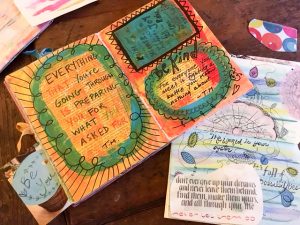
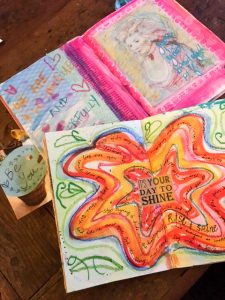
Have you ever wanted to try art journaling but need a nudge to get started? Do you journal or write regularly and want to take it to the next level by incorporating visual art? Do you want to learn some new techniques and get your hands on some inspiring prompts? Come and draw, paint, write, explore and create at our Introduction to Art Journaling workshop!
What You Will Learn
Working with your own personal journals, you will be guided through how to:
- Apply a variety of techniques to alter journal pages using a range of lettering, collage, foil, pastels, salt, acrylic paint, alcohol ink and a range of watercolour mediums.
- Carve your own personal lino-cut stamp, make foam-prints, and hand-cut your own stencils.
- Alter pages with folds, pockets, and found material.
- Learn how to build your own on-the-go art journaling kit so you can journal anywhere!
- Incorporate thought provoking prompts and inspirational topics to help you explore what it means to “Be You.”
What You Need To Bring
- A notebook. You generally want something portable (that is easy to pop in your purse or bag and not smaller than 5×7.Picking out a notebook is a very personally thing! Do you want lines or blank pages? Handmade paper or smooth pages?
- You can also choose to bring an old book and alter its pages, using them as backdrops for your work. Make sure the binding is secure and that pages are not coming loose.
- A black thin-line pen or marker. You will be using this constantly to sketch and write.
- A white paint or ink pen for writing or sketching over your pages.
Come with the basics and some of your favorite tools and we will provide the rest!
What We Will Provide For You To Use In The Studio
We have an assortment of:
- Pencils, ink pens, gel pens, and sharpies
- Wide range of papers, foils, tissue, textured and printed material.
- Scissors, paper cutters, tracing tools, templates, stencils, and rulers
- Tape (masking, washi, duct), glue, acrylic medium, gel medium, gesso
- Watercolours (pallet, crayons, pencils, pens), oil paint, and acrylic paint
- Chalk and oil pastels, stamping objects, ink, sponges, brushes, alcohol inks, fabric, and much, much more!
Is This Just For Artists?
Absolutely not! Art journaling can be done by anyone! Art journaling is your own personal place where you can experiment with colour, materials, textures, and script. You don’t have to show your art journal to anyone as they may contain your own personal thoughts and your personal creative expressions and that is okay!
It is the creative process that is important. Your journal is a place for you to work things out, to express your inner most feelings. It doesn’t have to be perfect as you are using your journal as a place to experiment with your creativity. Your art journal is yours alone and you do not have to discuss the content of your journal with anyone unless you wish to do so. We are always here and ready to assist you in any way.
Have Further Questions?
If you have any further questions, please contact Meg Neufeld at the office by calling (604) 283-7827 ext. 703 or by emailing meg@alongsideyou.ca and she will be happy to answer any questions you might have!
by Meg Neufeld | Mar 3, 2017 | Articles, Creative Arts Programs, In The Community

In honor of world book day, we thought we’d give you some examples of awesome books we’re using in the art studio! Check out your local bookstores for some of these titles and maybe you’ll find other gems out there! Feel free to share books you are reading, we’d love to hear from you!
1. Living Artfully: Create the Life You Imagine by Sandra Magsamen (2006) is about how to enrich your daily life in new and creative ways.
2. Imagination in Action: Secrets for Unleashing Creative Expression by Shaun McNiff (2015) shares stories and insight from therapists and educators who are using artistic and creative activities as a way to spark the creative process. Different techniques are described and case studies are explored.
3. Kesu’: The Art and Life of Doug Cranmer Jennifer Kramer (2012) records the life and times of Doug Cranmer, a renowned Kwakwaka’wakw artist know for his big personality and with a fierce love for his culture, his community, and teaching others. Meg Neufeld had the pleasure of meeting and interviewing Doug Kranmer in Alert Bay, BC, and her research has been incorporated into parts of this publication as one of his last interviews before he died.
4. Knitting Stories: Personal Essays and Seven Coast Salish-inspired Knitting Patterns by Sylvia Olsen takes a close look at Cowichan-style knitting designs through personal stories about history, family, culture, community and more recent fusions of the art. It contains beautiful photographs of both ancient and contemporary knitting designs that are interwoven with personal stories.
5. Journaling As a Spiritual Practice by Helen Cepero (2008) is book for beginners as well as experience journal writers that helps you go beyond the surface and guide with your relationship to God. Based on the authors own experience, each chapter contains journaling practices and helps to sharpen your focus on your spiritual journey.
6. Creating Together: Participatory, Community-Based, and Collaborative Arts Practices and Scholarships Across Canada (2005) by editors Diane Conrad and Anita Sinner explores newly developed approaches to research that combines art practices into community-based collaborative projects. Outlining several case-studies, contributors discuss art forms such as writing, mural projects, photography, and expressive arts, highlighting the positive and more challenging issues that arise during the process of creating and sharing collective knowledge.
7. Micawber by John Lithgow and illustrator C.F. Payne (2005) share a delightful children’s story about a squirrel who loves to paint. In order to explore his passion for painting, Micawber becomes a stow away in a painter’s bag, creating beautiful works using the tip of his tail. This inspiring stories shares that everyone can create, even a squirrel!
8. The Artist and Me by Shane Peacock and illustrator Sophie Casson (2015) explores the eccentric life of Vincent can Gogh in France in the 1880s who was mocked for looking unusual and creating strange paintings. No one was buying his paintings, yet he continued to paint. Using some of van Gogh’s famous paintings as a backdrop, this fictional story follows a young boy and his negative attitude towards the painter. By following van Gogh around, the boy’s attitude changes as he learns that everyone’s point of view is valuable.