by Jonathan Hers | Jan 2, 2024 | Children, Communication, Mental Health, Parenting, Teens
You walk in the door just in time to hear the wail of your daughter screaming as she runs into your arms.
Oh, Gosh! So much for decompressing! You quickly check for any significant battle wounds as you hold down the urge to get angry and start screaming yourself.
Her older brother peeks his head around the corner yelling, “It’s her fault! She started it!”
You’ve just entered a crime scene and have been invited into the position of judge and jury. How many times have we played this game, conducting a fact finding mission to solve the given mystery? What is clear is that these sorts of behaviours from your son have been increasingly frequent, even finding their way to school. Just last week your son was in the principal’s office.
What is happening!? This is a great question. The first question is not: HOW do I stop this aggression? But first: WHY is this behaviour happening? What we see is critical, and changes our parenting strategies.
Understanding Aggression in Kids
Here are a few things you might benefit from knowing when your child erupts with aggressive behaviours.
Beneath these aggressive behaviours are two subterranean forces that, when understood, can enhance your ability to connect with your child, help them avoid getting to the point of aggression, and ultimately help them mature and develop.
Being a Kid is Frustrating
The first step is to see their frustration. This is different from anger or aggression. Frustration is fundamental to life. From the second we are born we are met with things to be frustrated by: the absence of the safety and warmth of the womb, red lights that get in our way of getting to school on time, friends that are not available to talk when we call, our to-do lists that aren’t completed. Frustration is natural; a goal we have is not achieved, a need we have that is not fulfilled, or, at very least, the pursuit of a given goal or need is complicated.
When we are frustrated, we have a natural response: we attempt to change the situation. This is normal. However, often we find out quickly that much of life consists of things, people, and external factors that we CANNOT change. We hit the wall of futility. Something is going to happen, or is happening, that we cannot change. Despite the advances in science and technology that have allowed us to do so much that a few generations ago would have seemed impossible, this wall of futility is natural and normal.
Crying (or at Least Sadness) is Crucial
Second, what happens at this nexus is so important: we cry. Tears form in our eyes. Or a sense of disappointment gets stirred. This is normal. In fact, Dr. Gordon Neufeld says this is critical to our human ability to adapt and mature. No tears = no adaptation. A powerful insight to contemplate. Take a moment to think of all the times your child cries. Take a moment to reframe these tears as an essential part of their human experience. They are reckoning with the limits that life gives us. And this is healthy, part of their minds adapting, forming, growing as they mourn their inability to change what stands before them. How does this shift what you are seeing? Do you sense the respect rising for this process?
What happens when there are no tears? Aggression. Dr. Gordon Neufeld teaches that “when futility is NOT felt we get aggressive.” The tears are signals that futility is being FELT. We can be sad without tears but often tears are the natural expression of this felt futility.
So, it’s important to know that all this has to happen for aggressive behaviours to rise to the forefront.
What Are the Next Steps With My Child’s Aggression?
These insights now lead to some critical questions to ask when helping your child with aggression:
- Where is their frustration?
- What is the source of my child’s frustration?
- Where are their tears of futility?
- How can I identify and help my child express their tears of futility?
Dr. Gordon Neufeld describes the ideal position of the parent as both an agent of futility and an angel of comfort. This invitation is powerful. You are not a bad parent if you stop your child from getting what they want in every situation, even when this frustrates them, AND you get to be with your child in their disappointment and tears. It is essential to play both of these roles as a parent. We are double agents! This tension of saying no while also acknowledging their sadness is necessary for each child’s development and maturity.
Acknowledging these two key factors is a bottom-up approach to addressing aggression in children versus using social isolation or consequences as top-down attempts at stopping aggressive behaviours. Neufeld articulates that these two behavioural strategies often can backfire and create more frustration and less chance of children getting to their tears (key for their growth and maturity).
So How Do We Help Aggression in Kids?
Let’s look at these insights with the situation of your son’s hitting behaviour:
Yes, we need to stop your daughter getting hurt. So do that.
AND we need to see what is happening with your son within the context of these subterranean forces:
Where is his frustration? Does he feel disempowered at school? Is he feeling inadequate in his course work? Is he disappointed / frustrated at his height amidst other taller boys? Was he scared walking home from school alone and left judging himself for having this fearful reaction? Did his sister fail to consider him during their game?
Where are his tears? Can he express where he is experiencing the futility of life? Is he hungry for parental attention and hasn’t had a safe context to express these frustrated realities? How can I gather my child, collect his attention, and help him move from mad to sad?
This is the direction to go. It doesn’t solve immediate decisions like defusing intense situations but these two questions give you a direction to go in. Find the frustration. Find the tears. It’s not a quick fix solution to use, but it is the path that sets your child up to mature, adapt, and grow.
If you could use some help understanding and addressing your child’s aggressive behaviour, we’re here for you. Lean on us. We know that most of this is new – we didn’t grow up with this knowledge or understanding, and now we’re trying to understand it and put it into our relationships with our kids to help them thrive. It’s not easy, and we’re happy to help.

by Dr. Catalina Zilveti | Sep 7, 2023 | Anxiety, Children, Parenting, Tips
Some School Anxiety is Normal!
First things first, it is normal and expected for children to have some worries with regards to going back to school! School anxiety may include worries like:
- Who will be my new teacher?
- Will my friends be in my class this year?
- How will I do in math/language/etc. this year?
- Will this year be harder than last year?
These are social and academic concerns that all children can experience from time to time. In these cases, it is important for parents to recognize these concerns and talk openly with their child about them. At the same time, it is critical that parents listen and empathize, never dismissing or minimizing the child’s feelings. Children need to be heard, like all people.
Parents’ Reactions to School Anxiety:
On the other hand, if parents react with anxiety to their child’s worries, the child will pick up on this and it will only heighten their worries. The calmer a parent can be, the more likely they will be able to really listen to their child and offer support, rather than react based on their own worries. As a parent, I know it can be incredibly tempting to jump in and fix it, to make it all better for our children. When we do this however, we are not really helping our children. We are not allowing them to learn and grow from these experiences. Ultimately, our goal as parents should be to help foster resilience in our children, rather than to promote dependency. Life will always present us with challenges and struggles, among other things. As parents, we play an important role in helping our children build resilience during times of hardship, walking alongside them and supporting them.
One of the questions I am often asked by parents with regards to back-to-school anxiety is, “How do I know if it’s normal worrying or anxiety?” There are signs for which parents can be on the lookout including:
- school refusal
- stomach aches/headaches/nausea
- shutting down in school and/or refusing to participate
- changes in sleep and/or nightmares
- changes in appetite
- heightened sensitivity
- low frustration tolerance with behaviours like anger outbursts or crying.
How to Help Your Child
When parents see these signs in their child, it is important for them to step in and help their child. The key steps to helping our kid in these situations are:
- Acknowledge what the child is experiencing.
- Let them (if they are old enough) describe what they are feeling.
- Most importantly parents: listen to, and acknowledge what your child says, so that they feel seen, and heard.
Once you understand what your child is feeling and experiencing, the next step can be a conversation with your child about coping strategies. My experience has shown me that children often come up with the best strategies for themselves!
There are times, however, in which parents see that their child is overwhelmed and really struggling and they themselves feel they do not know how to handle the situation. At times like this, professional assistance may be warranted and helpful. I know I’ve been there, and I’d love to be there for you too!
Click here to contact us to get support for your child.

by Dr. Catalina Zilveti | Jul 24, 2023 | Children, Counselling, Mental Health, Play Therapy
One of the most common questions I’ve been asked by parents is, “What is play therapy, and why is it the preferred way to work with children in therapy?
When adults begin their counselling journeys, they use words to express and communicate their thoughts and feelings. Young children do not generally communicate this same way, often because they don’t have the language to express what is happening in their internal world. They use play instead of words and let their play speak for them. Through play, children communicate their thoughts, worries, feelings just like adults do with words.
A child’s natural inclination is to play. Through play they are able to learn about the world around them and themselves, for example, I like playing with blocks but not drawing. To an adult, play can look like an unproductive activity, but appearances can be deceiving. For children, play is serious business. It is never a waste of time. It is through play that children practice limitless things in a free and safe environment, until they have mastered them, preparing children for “the real world”- as adults call it- all without the child, or the child’s parents, realizing it.
Therapeutically, play gives the therapist a peek into the child’s rich inner world. The diverse ways in which children interact with different toys can reveal their feelings, fears, anxieties, desires, and past experiences. Children will act these out in their play and, at the same time, self-soothe/regulate, find novel solutions to problems, and learn.
What Is Play Therapy Helpful For?
Generally, play therapy is used with children between the ages of 3 and 12 years for presenting issues including, but not limited to:
- Problem behaviors at home or school
- Facing medical procedures
- Angry and/or aggressive behaviors
- Family divorce or separation, loss of a loved one in the family, birth of a sibling
- Natural disasters
- Traumatic events
- Domestic violence, abuse, or neglect
- Bullying
- Anxiety, depression, and phobias
- Deficits in social skills
- Repressed feelings
The play therapist will typically observe how the child plays during the sessions and may intervene from time to time, depending on the child and the child’s therapeutic needs. Sessions are tailored to each individual child. Therapy goals are assessed in the initial sessions and periodically, thereafter.
What Does a Session Look Like?
Toys and other items are set out in the session room so that children can reach them easily. My preferred method is allowing the child to choose the items he/she wants to use during the session, much like an adult will choose what to discuss in a counselling session. Items used in these sessions can include:
- Play-doh
- Paints, coloring pencils/markers and crayons
- Dolls
- Miniature house (simulates child’s house) with figures of family members and furniture
- Toy cars
- Doctor’s kit
- Play money
- Puppets
- Sand tray
- Board games and playing cards
- Legos
- Blocks
- Action figures
- A soft ball
As a play therapist, I find these sessions with children to be not only therapeutically helpful, but also great fun and incredibly rewarding professionally! I know that play therapy can be a bit mysterious for parents and I hope this article helps you understand it a bit more. If your child is struggling, I would love to work with them, and with you to see how play therapy could help!
If you’d like to know more, or book an appointment, click here to contact the Client Care Team. We love your little ones!
by Ava Neufeld | Sep 3, 2020 | Anxiety, Children, Connection, Education, Encouragement, Tips
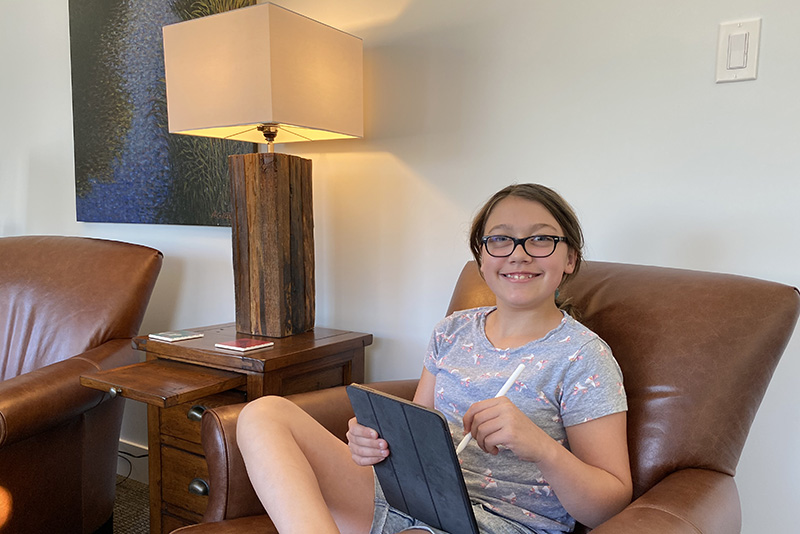
From The Directors: Today on the blog, we’re starting a new series. Our daughter, Ava is going to be writing for our blog from time to time. She’ll be talking about some of the issues she experiences and comes across with her friends, in school, and in life, to offer a perspective from a kid. We professionals can be helpful, but sometimes kids need to hear from kids. We hope this is something that some of your kids can benefit from and see that they’re not the only kid thinking of these things or struggling with things in life. We also hope that some of Ava’s tips will help them too!
Hello!
My name is Ava. I am a tween, and I have a sister and I have a dog named Buttercup – she is 10 years old. I love to do gymnastics and play with my beautiful dog. I love to bake, ride my bike, read, go skateboarding and last but not least, I LOVE TO PLAY WITH SLIME!!!!!!!!
You may be wondering why I love to play with slime, so here are a few reasons why:
- I have anxiety and learning disabilities. Playing with slime helps calm me down when I am nervous. I love the feeling of it in my hands and how the texture changes by what I put in it. It can be really smooth, soft, fluffy, wet or stretchy! Just having it in my hands helps me concentrate better.
- It helps me be creative and lets me experiment with ingredients such as, white glue or clear glue (optional), hand cream, glitter, clay (but add in after you activate), foam beads and shaving cream. For activator you can use borax, contact solution and tide, but only use one activator for one slime. Don’t use two activators in one slime.
- You can do this on your own or while social distancing with a friend. Or, you can make it online in FaceTime or Zoom – I like to do this with my cousins. It is a very soothing activity but it can get a little bit messy! It doesn’t take long to clean up! If it gets on your clothes just put the clothing in a bucket and put it in hot water to soak for 30 minutes to an hour and it will come right out.
Have fun!!!
I hope you enjoyed my blog today! Every once in a while, I’m going to write a blog that I hope will help some people. I know that I have a hard time with school and with anxiety sometimes, and I hope some kids out there will hear that it’s ok if things are hard. Life can be hard sometimes! I hope that some of my experiences and ideas might help you!
See you next time!
Ava
 Ava Neufeld is the newest author on our blog. She is a 12 year old student in the Delta School District and wants to share her perspective on life and challenges in the hopes that it helps others.