by Brenna Jacobson | Mar 7, 2017 | Articles, Case Studies, Trauma Sensitive Yoga, Yoga Therapy
Gentle Vehicles for Healing
Case Studies in Metro Vancouver, bases on real life experiences
Case Study #1: Ten year old Motor Vehicle Accident (MVA) resulting in the following chronic symptoms:
- Soft tissue injury in upper back and neck, exacerbated by a fall onto the left elbow.
Results after one month, using Physical Yoga Therapy and Techniques:
- Easing of pain in shoulder, which has resulted in improved sleep at night
- Greater mobility in movement of shoulders and arms
- Greater mobility and range of motion in neck
- Improved posture
- Improved mobility in hips
- Arthritis in facet joints, brought on by MVA:
Results after one month, using Gentle Yoga Therapy and Techniques:
- Nurture and maintenance of spine flexibility
These improvements have resulted in our client having more energy, and mental clarity, being free from the exhausting pain. The client also now knows and has the ability to self-regulate and correct as necessary. The client will move forward with back strengthening techniques, but for now is just enjoying being relatively pain free.
Case Study #2: Lung surgery in adolescence – Resulting in severe Apnea until present age of early sixties, including misaligned left shoulder and hip due to compensating for breathing imbalance.
Results after two and a half months, using a combination of Physical Yoga Therapy and Trauma Sensitive Yoga Therapy Techniques:
- no longer anticipating the next breath
- improved posture, increased lung capacity for the breath
- shoulder position greatly corrected with posture
- increased left hip mobility with a greater range of motion
- client demonstrates greater confidence and a lighter, happier state of being
Case Study #3: Previous student of yoga for many years. No longer able to practice due to fibromyalgia, depression, anxiety, resulting in tension in jaw & neck.
An example of how what happens in the mind is reflected in the body.
Results after 3 months, using a combination of Physical Yoga Therapy and Trauma Sensitive Yoga Therapy Techniques:
- Noticeable decrease in anxiety. The client demonstrates a lighter presence where there used to be heaviness
- Release techniques have greatly reduced the jaw and neck tension
- Gentle therapeutic program, designed for the client’s particular needs, has allowed for a return to home-based practice and resulting in becoming comfortable in one’s body, and eventually returning to group sessions
- Trauma Sensitive Yoga Therapy breathing techniques and guided meditation to rest the body and mind, enables the client to stabilize and stay grounded
- Gain key ability to tune in and listen to one’s body in order to be able to self-regulate at first sign of tension, anxiety and stress
- Letting go of anxiety and tension using gentle therapeutic yoga practice, the aches from the fibromyalgia have decreased due to improved circulation, and the release of uptight muscles and joints
___________________________
Our yoga focuses on addressing the root of the issue before deciding, alongside you, what the goal of your yoga practice is and how to address this through therapeutic yoga. Your planning with our professionals will look at your overall physical, mental, emotional, and spiritual wellbeing and how therapeutic yoga can help you address these areas.
Have questions? Call Brenna at (604) 283-7827 ext. 709 or email brenna@alongsideyou.ca.

by Andrew Neufeld | Mar 3, 2017 | Announcements, Group Therapy, Occupational Therapy, Yoga
There’s a lot of excitement around here at Alongside You! Anyone who knows us well knows that we’re always looking to fill gaps, improve services, and find more ways to help our community. This is why we’re expanding! Here’s a taste of what’s been going on, and what to expect in the coming months!
Brand New Yoga Studio
Surprise! We’re almost finished building our new yoga studio (the trim is being put in as I write this). Why are we building a dedicated yoga studio you might ask? Aren’t there enough around already? Well, in short – no, there aren’t enough, and they aren’t like ours is going to be. We’re providing a different service here at Alongside You, and we need a space that reflects that. We focus primarily on yoga therapy and trauma sensitive yoga here in our clinic, and our studio will be set up as an ideal environment for these highly personal, individual sessions with our lovely Brenna Jacobson. As great as our art studio and private offices are, they aren’t ideal for this kind of work so we’re creating what is needed to serve our clients better.
What about yoga classes you might ask? Well, we’re going to have those too. But they’re going to be different. We’ll be focusing on small class sizes, because we hear time and time again that the size of classes is overwhelming for people. We’re going to focus on specific topics and build customized yoga programs to suit. I’m not going to let the cat out of the bag completely, but we’re going to start with kids, prenatal yoga, and Hatha Yoga 101 for Beginners. Coming down the pipe are things like yoga for anxiety, chronic pain, and much more. But one thing at a time! Stay tuned to our website and social media for all the details!
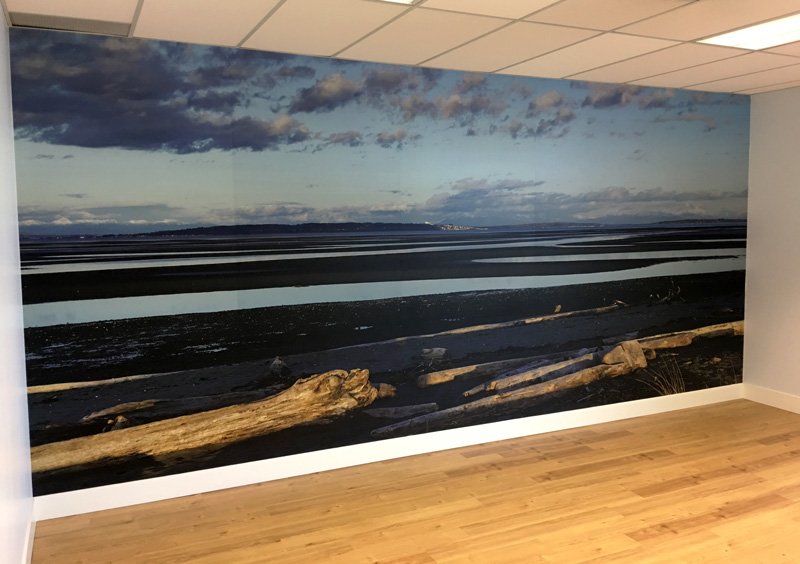
We also wanted to bring the outdoors into the studio. So, as always, we’re working with the fabulous Tyler Garnham, and we’ve found an image local to South Delta that will be installed in our studio, filling up the entire north wall. This will give us, and our clients a feeling of space, and connection to our local surroundings even while inside. I can’t wait, it’s going to be amazing!
Occupational Therapy
We love our OT, Kristin Beare, but she’s busy tending to her own kid right now. Our yoga studio is going to do a little bit of double duty and be a space for our OT to work with clients. The larger space will give much more freedom for mobility-related concerns, sensory work, and so much more! We’re also building customized storage into the new wing so that we have more tools at our fingertips. She’ll be back later on this year, and I can’t wait to see what she does with the new space with her clients. Stay tuned!
Clinical Office
Ok, this isn’t super exciting to you maybe, but it’s exciting to me. We’re building a new office that is set up more ideally for neurofeedback for clients, and for our Neurofeedback guru, Jonathan Wieser. Our other offices have worked fine, but this is going to be better. It will also be used by other counsellors, which gives us more available office space and flexible times for clinicians so that we can be more available to you as we expand! Growth is good, and we’re growing our hours to serve you better!
Group Therapy
So, the studio is also going to be used for group therapy. We already run a Dialectical Behaviour Therapy (DBT) group, but we’re expanding our group therapy offerings. Between our art studio where we do our DBT, and the new group room in the yoga studio I’m pretty sure we’re going to have the coolest group therapy spaces around. Why is this important? Because I hear all the time how much our clients appreciate being in creative, beautiful spaces while they’re in our care. It makes a difference! I can’t yet reveal the new groups we’re going to be running, but we’ll be using the new space for our Adult DBT Group, Youth & Family DBT Group, and soon enough, some others!
This is awesome, so when do we get to see the new spaces and use them?
You’re not going to have to wait long! We’re opening March 1st, and our individual yoga clients will get to use the space right away, as will our neurofeedback and counselling clients. Stay tuned, because we’re opening things up throughout March for Kids Yoga over Spring Break, and following that up with Prenatal Yoga and Hatha Yoga 101 for Beginnings toward the end of March and into April.
I hope you’re excited because we are! We can’t wait to show you the new spaces, and more importantly, be even better equipped to serve you well. South Delta is our home, and we’re growing thanks to your help! Whether you’re in Ladner, Tsawwassen, North Delta, or beyond, please come check out our new digs and see what we have to offer. We’d love to meet you!
To be the first to find out about all of the new things going on, make sure you follow us online at Facebook, Instagram, or Twitter.
by Meg Neufeld | Mar 3, 2017 | Articles, Creative Arts Programs, In The Community

In honor of world book day, we thought we’d give you some examples of awesome books we’re using in the art studio! Check out your local bookstores for some of these titles and maybe you’ll find other gems out there! Feel free to share books you are reading, we’d love to hear from you!
1. Living Artfully: Create the Life You Imagine by Sandra Magsamen (2006) is about how to enrich your daily life in new and creative ways.
2. Imagination in Action: Secrets for Unleashing Creative Expression by Shaun McNiff (2015) shares stories and insight from therapists and educators who are using artistic and creative activities as a way to spark the creative process. Different techniques are described and case studies are explored.
3. Kesu’: The Art and Life of Doug Cranmer Jennifer Kramer (2012) records the life and times of Doug Cranmer, a renowned Kwakwaka’wakw artist know for his big personality and with a fierce love for his culture, his community, and teaching others. Meg Neufeld had the pleasure of meeting and interviewing Doug Kranmer in Alert Bay, BC, and her research has been incorporated into parts of this publication as one of his last interviews before he died.
4. Knitting Stories: Personal Essays and Seven Coast Salish-inspired Knitting Patterns by Sylvia Olsen takes a close look at Cowichan-style knitting designs through personal stories about history, family, culture, community and more recent fusions of the art. It contains beautiful photographs of both ancient and contemporary knitting designs that are interwoven with personal stories.
5. Journaling As a Spiritual Practice by Helen Cepero (2008) is book for beginners as well as experience journal writers that helps you go beyond the surface and guide with your relationship to God. Based on the authors own experience, each chapter contains journaling practices and helps to sharpen your focus on your spiritual journey.
6. Creating Together: Participatory, Community-Based, and Collaborative Arts Practices and Scholarships Across Canada (2005) by editors Diane Conrad and Anita Sinner explores newly developed approaches to research that combines art practices into community-based collaborative projects. Outlining several case-studies, contributors discuss art forms such as writing, mural projects, photography, and expressive arts, highlighting the positive and more challenging issues that arise during the process of creating and sharing collective knowledge.
7. Micawber by John Lithgow and illustrator C.F. Payne (2005) share a delightful children’s story about a squirrel who loves to paint. In order to explore his passion for painting, Micawber becomes a stow away in a painter’s bag, creating beautiful works using the tip of his tail. This inspiring stories shares that everyone can create, even a squirrel!
8. The Artist and Me by Shane Peacock and illustrator Sophie Casson (2015) explores the eccentric life of Vincent can Gogh in France in the 1880s who was mocked for looking unusual and creating strange paintings. No one was buying his paintings, yet he continued to paint. Using some of van Gogh’s famous paintings as a backdrop, this fictional story follows a young boy and his negative attitude towards the painter. By following van Gogh around, the boy’s attitude changes as he learns that everyone’s point of view is valuable.


by Brenna Jacobson | Feb 17, 2017 | Trauma Sensitive Yoga, Yoga Therapy
With 2017 underway, this is a good time to consider different solutions to manage many of life’s problems and opportunities. Did you know that Yoga can be utilized for treating various conditions? Built on thousands of years of knowledge, Yoga is not just a physical exercise or something to relax your body and mind over the weekend. Yoga Therapy is a type of therapy that can reduce pain and suffering for people with different physical conditions, whereas Trauma Sensitive Yoga is a type of clinical treatment for treating trauma.
The power of Yoga Therapy to change lives is what has drawn me to it as a teacher. Starting by working on myself, it allowed me to regain control of my life and improve the quality of life, physically through Yoga Therapy and psychologically through Trauma Sensitive Yoga.
Yoga Therapy teaches people how to allow healing to occur. In teaching Yoga Therapy, I become the facilitator of healing. By getting to the causes and conditions required for healing, healing will naturally arise once everything is in place.
What Does a Yoga Therapist Do?
There are spaces in the medical community where Yoga Therapy fits. Part of the job of educating people is to properly distinguish Yoga Therapy from Studio Yoga. Well, the good news is, people are becoming very curious about it!
The IAYT (International Association of Yoga Therapists) has been in place for the last 7 years, and holds an annual conference, at which amazing presenters bring forward new concepts in Yoga Therapy and bring the therapist community together.
For example, Dr. Baxter Bell, who is an M.D., became a Yoga Therapist as it allows him to treat the entire family. Yoga Therapy supports healthy ageing, and can be applied to young and old, middle-aged citizens as well as seniors.
What is Yoga Therapy?
It’s not Studio Yoga. It is an amazing tool that can be taught to a student and be used on their own at home after a few sessions, with success. Any situation that has taken you to a chiropractor, physiotherapist, or a myriad of other physical therapy modalities, can also be treated with Yoga Therapy.
You do not need to have experience in any form of Yoga. Yoga Therapy comes from a thorough education of the human anatomy. It is biomechanical and the integration of all systems –the key is the mind – body connection. With many physical conditions, there is a corresponding psychological component, whether it is a result of a motor vehicle accident, Post-Partum Depression, infertility or urinary incontinence, just to name a few.
What is Trauma Sensitive Yoga?
Life is traumatic, it just depends on the degree! Yoga, particularly Trauma Sensitive Yoga (TSY) can help us to reconnect to our body and feel at home in our own shell. It can help us learn to blend our experiences into our daily lives. Through exploring yoga and mindfulness, we will be able to better thrive emotionally. In turn, we can contribute to our own wellbeing, and beyond into our communities. Students learn simple, body-based self-regulation techniques that will help to build resilience in their bodies. They will be able to better equip themselves to manage stress, trauma, depression, anxiety and rediscover the true self and feel comfortable in their own skin.
Through this gentle yoga practice the internal experience is emphasized, you will be free to make choices in a safe, supportive place of embodied empathy and attunement. Trauma Sensitive Yoga is an ideal adjunct to psychotherapy.
Trauma survivors are often referred for Trauma Sensitive Yoga by their healthcare providers to cultivate, “the simple body awareness that makes it possible to gauge, slow down, and halt traumatic hyper-arousal, and to separate the past from present (Rothschild, 2000)”
I hope this helps explain some of the intricacies of Yoga Therapy and Trauma Sensitive Yoga for you, and if you have any questions I’d love to answer them! We truly believe in the power of yoga in physical, mental, and emotional well-being here at Alongside You and would love to see you experience it firsthand!
___________________________
If you’d like some help to manage your emotions and anxieties, we’d love to help. Please give us a call at 604-283-7827, send us an email through our website, or book an appointment online and one of our counsellors would love to help you out!

by Juliana Fruhling | Jan 25, 2017 | Anxiety
These days anxiety is on the rise, thanks in large part to the increase of using numbing out, or disconnecting, to deal with strong emotions. It’s become somewhat of an epidemic, perhaps due to the now widespread use of screens and smartphones, for people to disconnect from their emotions and numb them out instead of soothing them or working through them. Disconnecting in and of itself is not a negative thing – it’s crucial to be able to disconnect from our emotions if we need to get things done, or if we’re not in a safe place. However, the temptation to stay disconnected is huge with so much to distract us, and this can prevent us from attending to and resolving our feelings, or even taking some time to self-soothe.
By being more intentional about connecting to our bodies and learning self-soothing mechanisms we can help decrease anxiety when it begins to rise in us and feel safer in general when navigating our day-to-day lives.
Here are three simple ways to help soothe and reconnect when anxiety arises.
- The 1-2 breath – During times of higher anxiety, our bodies switch into a kind of a survival mode, where our sympathetic nervous system activates and causes us to breathe more rapidly, seeking to increase the oxygen in our bodies and make us “ready for anything,” so to speak. This is an exhausting state to remain in, and can leave us tired and irritable by the end of the day. In this state, often unbeknownst to us, our breathing patterns become more rapid and shallow, and the focus is on the oxygen-inducing inhale, rather than the carbon dioxide-releasing exhale. By paying attention to one’s breathing and focusing on establishing a pattern of shorter, expansive inhales, and longer, slower exhales, the body is invited into a state of relaxation and safety, and it naturally calms and regulates. This can be achieved by breathing into a count of “one Mississippi”, and out to a count of “one Mississippi, two Mississippi”. This is best done in a quiet, calm environment, and placing one hand over the heart and one hand on the stomach during this breath can help facilitate the connection, and help the body focus on slowing down and calming.
- Grounding/Rooting down – When anxiety is quickly rising in our bodies it can be quite an intense experience, one that can even feel like an out-of-body experience, which is a very helpless feeling. Anxiety intensity is usually dominant in the upper parts of the body – churning stomach, pounding heart, racing head, sweaty palms, etc. In order to soothe this, it can be helpful to focus yourself on rooting down, moving yourself to a safe space if possible and focus on the lower, calmer parts of the body, the feet, the legs, the bottom or lower back – any place that is connected to something still and stable, like the floor or a chair. Breathing and getting heavy and focusing on those safe connecting points, even imagining one’s feet as tree trunks, rooting strongly into the ground, can help the body quickly cool down from the rapidly rising anxiety and help it to feel safer, more connected and stable.
- Sensory tools – another thing that can help ground the body during rising anxiety is to have available a few sensory items that are relaxing and soothing. For those who find tactile items and the sense of touch soothing, keeping a piece of soft blanket or cotton balls, or even sandpaper handy can help – something to hold and focus on in the midst of rising anxiety. For those who find scent soothing – like something reminiscent of a mother’s perfume or a favourite baked item, they can keep a bottle of lotion, perfume, or essential oils handy for calming.
Likewise for those who find music soothing, having a certain song or meditation ready to play to help them breathe and cool down can be helpful. Even taste can help with soothing – having a piece of gum or a jelly bean of a certain flavour. Creatively seeking out things that help soothe the body and having them at the ready in a little, pocket sized “anxiety survival kit” can be a huge help when anxiety unexpectedly arises.
I hope this has been helpful for you and gives you some tips to help manage your emotions and anxieties. Often it helps to go through these with a professional, and sometimes our emotions and anxieties are beyond what we can manage on our own. If you’d like some help, please let us know, that’s what we’re here for!
___________________________
If you’d like some help manage your emotions and anxieties, we’d love to help. Please give us a call at 604-283-7827, send us an email through our website, or book an appointment online and one of our counsellors would love to help you out!
by admin | Jan 6, 2017 | Announcements, Press Release
Furthering our mission to provide excellence in healthcare in Metro Vancouver

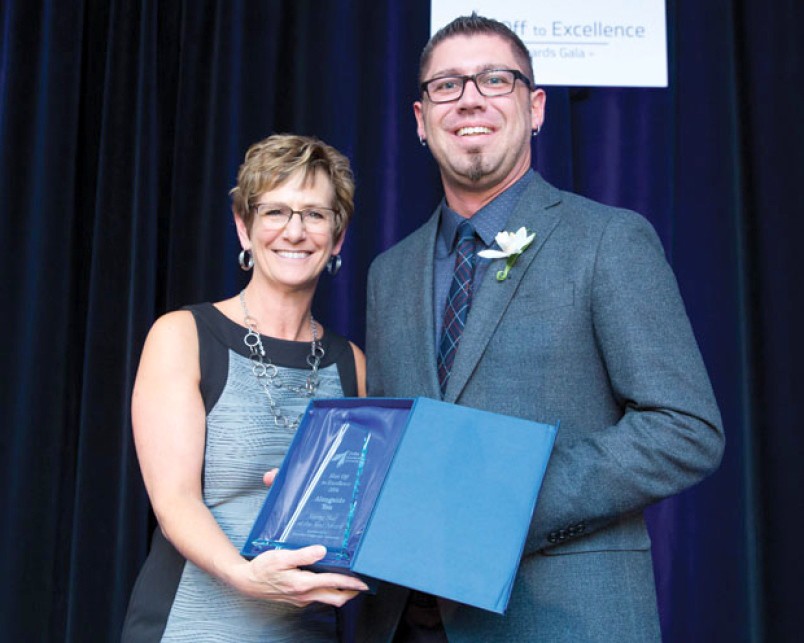
Delta, B.C., December 9, 2016: Alongside You is extremely grateful to be recognized by the Delta Chamber of Commerce and Kwantlen Polytechnic University with the Rising Star of the Year award. The Rising Star of the Year is an annual award given to a Delta-based business that has shown significant operational success and growth potential.
Everyone at Alongside You are excited about the award because it validates their business model, and their impact on the community. Co-Founders Andrew Neufeld and Meg Neufeld set out to run an ethical, professional service that filled gaps in the public system and met the needs of the community, and did not discriminate on diagnosis, ability, or financial status.
Alongside You is special because it is not just a business, it is a mission.
Their mission is to provide excellence in healthcare, meet the financial needs of their clients in a compassionate way, and provide a work environment that allows their staff to thrive. Their staff buy into the vision – and this is the reason it works. For Alongside You to provide the care for people that they do, their staff make personal sacrifices alongside them.
What further sets Alongside You apart, is that they have a fund set up called the Step Forward Fund that further subsidizes services for their clients who need some extra help. Alongside You runs events and all proceeds from these events go into the fund. They also have generous members of the community who see the work they are doing and get on board, donating time, and money to help the cause. Everyone at Alongside You is blown away by the community’s involvement in their work as they do not receive any tax benefits for their donations as they are not a non-profit. Everyone at Alongside You pours their heart and soul into the community, and the community has responded and helped them achieve their goal: to do the right thing, at the right time, for the right reasons because it is the right thing to do.
“Our hearts are to reach out to the community, find those that are not being reached by the public or other services and find a way to serve them and meet their needs. Professional, ethical, and effective health care takes not only a commitment on the part of the business owners, but also their staff as well as a community that embraces the services provided. This is our mission at Alongside You, and this has been our experience in our community. We are grateful to be a part of our local community and look forward to many more years of transformational leadership in health care in the Greater Vancouver area.” – Andrew Neufeld, Co-Founder of Alongside You
Jane Philpott, the current Minister of Health in Canada, once stated that innovation would be the key to problems in Canada’s healthcare system. Alongside You believes that by utilizing innovative programs like the Step Forward Fund and establishing the kind of community partnerships they have, health agencies across the Lower Mainland can better serve clients of all backgrounds and people with all kind of needs more effectively and efficiently, filling a gap that needs much attention.
If you would like more information about what Alongside You is doing in the community, please contact Andrew Neufeld at 604.283.7827 ext. 701, Meg Neufeld at ext. 703 or email them at info@alongsideyou.ca.
About Alongside you: Alongside You is an integrated health agency in Ladner. We offer counselling experience that is compassionate and constructive, professional and personable. Our goal is to help you move forward towards a healthy, fulfilling life. Alongside You is recognized by the Delta Chamber of Commerce and Kwantlen Polytechnic University with the Rising Star of the Year award in 2016.
Address: 203 – 4840 Delta Street, Ladner, BC, V4K 2T6
Phone: 604.283.7827
Email: info@alongsideyou.ca

Image source: Delta Optimist

by Andrew Neufeld | Dec 15, 2016 | Articles, Counselling
Joy To The World?
I have long had a love, hate relationship with this time of year. You may remember this from my post last year right around this time about how to manage holiday stress. I love that this time of year often brings families together, sometimes travelling long distances to do so. I love that it brings local communities together to celebrate the holidays. What I truly love most is that I make a point of taking time off at this time of year to be with my family, particularly my wife and kids. What is even better is that they also have time off at this point in the year and we can be together. I often work fairly long hours, and between my schedule and my wife’s schedule, and the kids’ activities, it’s a challenge to get time each day to be a family. This is what I look forward to this time of year, with great anticipation. This is what brings me great joy at this time of year – being with my family.
What I haven’t put into words before, however, is my difficulty with taking time off over the holidays. With the type of work that I do, I know full well how many individuals, couples and families struggle this time of year. I also know that tragedy does not wait for holidays to pass because it’s not “a good time.” The past month seems to have had more than its’ fair share of tragedy. I’ve seen this personally, professionally, and in the news in our community. Friends have lost loved ones, family members are dealing with illnesses, clients are struggling. Although the common belief that suicide rates are higher over Christmas is not true, what is true is that for all of the joy of Christmas, there is a lot of pain and suffering to go along with it.
What do we do about the juxtaposition of joy and pain over the holidays? I believe that a lot of it comes down to perspective and what we choose to focus on. Even more, what it comes down to is acceptance. Dialectical Behaviour Therapy has a concept called radical acceptance, which is a very simple, yet very difficult concept to put into practice. What it means is that we have to be willing to accept that thing happen in life that we do not like. It does not mean that we have to agree with these things, like these things, or are even okay with these things being the way they are. What it does mean is that we have to accept that these things are indeed present in our lives, and it is what it is. What other choice to we have? If we fight against it, we will most likely become anxious, depressed, and stressed out.
I’ve been reflecting on what I need to accept this year in order to be able to leave the office for a week of holidays, enjoy Christmas with my family, and most importantly, be present when I am with them. Here are my three things and I hope they may be helpful in some way to you as well.
- Accept that in order to take care of others, I need to take care of myself.
This time of year is difficult for many, and I often feel pulled to remain at the office this time of year. The reality is that with my clinical practice and the growth of Alongside You, there really is no good time to take a break. There will always be things to do, clients to see, and I will always be conflicted about taking time off. The truth of the matter is, we all need a break and I definitely need one at this point in the year. I often use the analogy of the oxygen mask in an airplane with my clients – they tell you to put your mask on first because if you don’t and you pass out, you won’t be able to help others. I need to take some of my own medicine on this one.
- Accept that this time of year will always be a mixture of joy and sorrow, and possibly some stress.
I know that I will experience much joy over the next few weeks as I spend time with my family. I know that as I leave the office tonight and go to my kids’ school Christmas concert I will be filled with pride, overwhelmed by my love for my children, and enjoy every minute of it; in fact, I’m tearing up just as I write this. I know that my kids will look out into the crowd to find me, because it means so much to them that I am there, and am present.
I also know that no matter how carefully we plan, how much we try not to do too much, there will always, always be things that mess up the calm. Part of the amazing thing about Christmas is how many awesome things are going on. I also know that I get overwhelmed by all of these awesome things if I am not careful. I know that I need to take time for myself, keep myself balanced, and yes, practice some of the mindfulness skills that I teach my clients and hound them about.
Finally, I am all too aware that many of my clients, my friends, and my family will be struggling through this season. The pain of the loss of loved ones, lost jobs, ill health, and so many other things does not take a break because of Christmas. I know that they will need comfort, support, and love and while I will do my best to be these things for as many as I can, I have to trust that others in their lives will do the same.
- Accept that I must focus on the joy to endure the sorrow.
Our brains are well trained to focus on the negative, and my brain is no different. It takes very little effort to notice, and remember the negative. It takes much more effort to do the same for the positive. This is not about denial, it is about intentionality. Dialectical Behaviour Therapy describes this as a validation of our situation – that is, being able to find the silver lining in any situation while not denying that the cloud we are surrounded by is indeed black. I am fortunate – this year, I feel very positive about life and the upcoming holidays. This has not always been the case, and I can identify with many who might be wondering how to find the silver lining in a black cloud.
I am challenging myself, and I welcome you to join me in this, to be intentional about looking for the joy this Christmas. We don’t have to deny the pain or sorrow, but we can choose to focus on the positive. The truth is that no matter how black we may feel the cloud is, there is always something positive to be found – the elusive silver lining. If we can’t find joy this season, we may not be looking hard enough.
From all of us at Alongside You, we wish you a wonderful Christmas and rest of the holiday season. We are grateful to be a part of your lives and are privileged to work with you through the joys, and the sorrows. May your lives be filled with joy as we finish 2016 and we look forward to 2017.
by Meg Neufeld | Dec 4, 2016 | Creative Arts Programs
Celebrate the art of making things together!
Weekly themes are demonstrated in the first 15 mins of Open Studio time. Participants are free to create art pieces related to the weekly theme or can explore art activities of their choice.
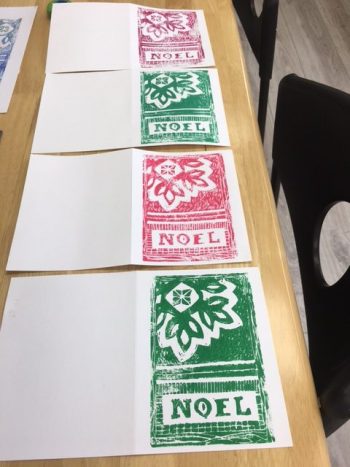
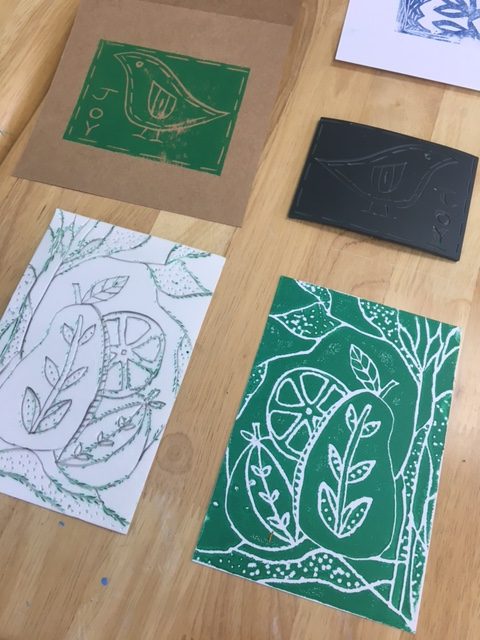
Foam-Printed Cards – Monday December 5th and Wednesday December 7th
Create your own personalized foam stamp and make an endless number of cards for the special people in your home and work life! Learn the basics of speedball-printing techniques and make a printed art piece to take home or give away!
Decorations and Wreaths – Monday December 12th and Wednesday December 14th
Get into the holiday spirit and create your own unique multi-medium wreaths, decorations, or tree ornaments using a variety of materials such as: buttons, fabric, cardboard, and paint. From traditional and contemporary, to the subtle and whimsical, come explore some neat ideas while materials are at your fingertips! Make it for yourself, or give it as gift!
Gifts Galore – Monday December 19th and Wednesday December 21st
Come and make some personalized gifts for friends and family. You can make wood-burned boxes, picture frames, wooden spoons or cutting boards, air-drying clay pendants and beaded jewelry, or paint a picture — the options are endless.
Need a gift for someone you love? We have Gift Cards!
Think outside the box and give the gift of creativity to our Open Studio Sessions. Come along to create an unforgettable time of making and sharing, or send loved ones on their own for some much-needed down time. Gift cards can be purchased in person at our clinic, or can be purchased online in our online store by clicking here!
by Andrew Neufeld | Oct 14, 2016 | Counselling, Workshops

Strong Parents, Healthy Kids
Thursday November 17th, 6:30-8:30pm
Location: Alongside You – #203-4840 Delta Street, Ladner
Presenters: Andrew Neufeld, Registered Clinical Counsellor and Kathryn Barczi, Registered Social Worker and Gottman Certified Bringing Baby Home Educator
Cost: $49 per single/couple (plus GST)
Click here to register now!
Availability: We require a minimum of 3 individuals/couples and a max of 6 to run the workshop. We will refund all fees if a cancellation occurs and will give as much notice as possible to clients.
One of the most common things we hear in couples with kids is how there’s no time to work on their own relationship. We’re all too busy with the kids. We have it all backwards. In this workshop we will introduce you to the causal relationship between the strength and satisfaction of your relationship, and the health and well-being of your child. If you want your kid to be healthy, it’s time to invest in yourselves. We’ll look at:
- What can happen to parents and children if the transition to parenthood is difficult
- How to recognize if your relationship is in trouble
- Recognizing the power of a satisfied relationship
- 3 ways to create a Culture of Appreciation
- The 5-step strategy for relationship success
Have questions? Please email Kathryn at kathryn@alongsideyou.ca and she’ll be happy to answer any questions you might have!

by Scott McNeil | Oct 6, 2016 | Articles, Counselling
Your heart’s pounding, you can’t breathe, it’s hard to think and you feel an uncontrollable urge to escape or run away. Other symptoms could include; your stomach in knots, tension throughout your whole body and feelings that are overwhelming. Are you finding it difficult to cope with everyday situations or uncertainties of the future? Is it hard for you to control your body’s reactions when faced with these situations? These emotions are often identified as fear, anxiety, or stress.
Every person on the planet can relate to feeling anxious or stressed at some point in their lives. However, there are people who experience anxiety every day. Does this sound like you? If it does, don’t stress– there’s nothing wrong with you. Stress is your brain’s normal way of responding to impending danger or threats. Whether it is a general fear of the uncertainty of the future or specific fears such as embarrassing yourself in public, the fear you feel is actually your body’s way of protecting you. All people experience similar types of emotions when they are under threat or danger.
But what can you do about it? Sometimes, it’s hard for people (who’ve never felt such crippling anxiety) to understand what you’re going through. Your friends and loved ones might be telling you to simply relax or avoid the fearful emotions you’re experiencing. While they may have good intentions at heart, their advice doesn’t help and can further aggravate your mood.
What Causes Anxiety?
People get afraid of anxious sensations in their body (like your heart beating faster). They are also often afraid of the future. Think about waiting for those test results or waiting for the employer to get back to you after a job interview. How did you feel? It’s often thoughts about uncertainty and the future that drive our anxiety.
Acknowledging your anxiety and understanding what it is about the situation that causes you to feel anxious may help. Sometimes your brain senses danger even when other people around you don’t seem to feel the same way you do. And that’s okay. Not everyone processes external stimuli the same way. One person may feel like they’re in danger while another person standing next to them may feel perfectly fine. Knowing that everyone’s different can help you cope with your anxiety. The thing is sometimes our brains do things unconsciously. And sometimes this stuff may be based on past experiences that told us something was dangerous. Our brains’ uncanny ability to function unconsciously can be helpful in some circumstances. Take breathing for example: if you had to concentrate on that, you would never get anything else done! It’s the same when it comes to danger. Brains can unconsciously sense danger. Experiences that seemed to be dangerous in the past stick with us and our brains will tend to keep alerting us when faced with similar situations.
If our brain spots danger, it automatically equips our body to deal with the threat. It does this by releasing hormones into our system. These hormones increase our heart rate, our breathing gets faster and more shallow, and we sweat more. This is what anxiety feels like. Once we get away from the threat or danger, the feeling decreases. But we also lose the chance to find out if what our brain recognized as dangerous was truly dangerous. I often hear people say, “But it just happens to me, no particular situation causes it.” This is a common thought. But here is the thing: remember our brains look out for danger and send signals of anxiety subconsciously. However, if there are truly no outside triggers for the anxiety, we should look inside us.
How Cognitive Behavioural Therapy Can Help
Okay, so you’ve learned about the causes of anxiety and made sense of what causes these unwanted feelings. Now what? One form of therapy known as Cognitive Behavioural Therapy (CBT) has been known to help reduce anxiety.
CBT shows us that humans need to learn through doing. Humans that are anxious about a threat when no threat exists may benefit from learning why everyone else isn’t scared when they are. What CBT has demonstrated is that if humans can stay with the feeling of anxiousness for long enough and the thing that they fear does not occur, then their brains learn something new. What the brain learns is that the thing it thought was dangerous actually wasn’t. We have probably all experienced something like it. Feeling anxious about learning to drive, going to a new job, meeting a first date. We all know the anxious anticipation coupled with the thoughts, “Will I crash, make a fool of myself, get dumped?” And for anyone who has managed to stay in the moment, they probably noticed their anxiety reduced. If they experience the same situation often enough, they might notice their anxiety reduces over time as more time passes. The brain is good at learning through many different ways such as visually, orally, aurally, or physically. But when it comes to conquering fear, the best way is to experience it physically.
“Where does that leave me”? I hear you say. I don’t want to feel this way and you are telling me the only way to conquer this feeling is to face it. Well, the saying, “The only way to conquer your fears is to face it” carries some truth. People who go into situations they fear and stay there for long enough, start to notice that their fears do not materialise. This can be a very empowering and esteem building experience. Of course, it’s also a difficult thing to do. More difficult for some and easier for others. Some people might need help while others might be able to deal with it alone. You’re not alone if you feel like you can’t handle it on your own.
Additional Resources for Anxiety Relief
Here are some places you can get some help on your own if you’d like to try:
- These self-help booklets have some helpful advice for different problems. The booklets also have references for more detailed self-help books.
- Go to your family doctor and ask him/her about Bounceback a CBT program that is free of charge.
- Take a look at a series of books entitled Overcoming. For example: Overcoming Panic Attacks. These evidence-based self-help books are available at Amazon usually for less than $20.
Alternately, if you’d like some help figuring this anxiety thing out – we’re here to help. I specialize in Cognitive Behavioural Therapy. I’d love to do what I can to help you beat this brain frenzy we call anxiety. We also have other counsellors at Alongside You. As well, we offer alternative methods for coping through yoga and creative arts that are a great help to people. Even if you just want to chat about taking the first step, give us a call. It’s what we’re here for.